

Apparel has one of the highest return rates in ecommerce. 25% of online clothing purchases come back. For brands shipping tens of thousands of orders a month, those returns add up to a second supply chain running in reverse.
Yet most brands haven’t built the operations to match that volume. Returns get treated as a cost center: print a label, issue a refund, move on. Reverse logistics for apparel goes beyond labels and refunds. It’s the system that decides what happens to every returned item: Does it go back on the shelf? Does it need reprocessing first? Is it unsellable?
This article breaks down what apparel reverse logistics actually involves, why it matters for your margins, the five steps of a solid returns workflow, and when it makes sense to hand it off to a fulfillment partner.
What reverse logistics for apparel actually means
Forward logistics moves products from manufacturer to warehouse to customer. Reverse logistics is everything that happens when a product travels the other direction, from customer back to the business.
For apparel, reverse logistics includes:
- Receiving and identifying returned items
- Inspecting garments for wear, stains, missing tags, or other issues
- Reprocessing items so they’re sellable again (rebagging, retagging, lint rolling)
- Routing each item to the right destination: back to stock, into quarantine, or out for disposal
Clothing is subjective. A “lightly worn” dress means something different to every customer. Sizes, colors, and seasonal relevance add layers of complexity that don’t exist for electronics or shelf-stable goods. And every day a returned winter coat sits unprocessed in spring is a day its value drops.
Taking these factors into consideration makes the process more nuanced and requires a standardized process just like forward logistics.
How poor reverse logistics erodes apparel margins
Returns cost money. But slow, disorganized returns cost even more (and often in ways that don’t always show up on a profit and loss statement).
- Labor adds up fast. Each returned garment needs to be opened, matched to an order, inspected, and routed. Without clear processes, warehouse staff spend time hunting for information instead of moving inventory.
- Seasonal value disappears quickly. A swimsuit returned in September won’t sell at full price in October. Apparel is time-sensitive. Every week a returned item sits in limbo, its recovery value shrinks. Brands that can’t restock fast end up tying up capital in inventory that won’t sell.
- Warehouse space isn’t free. Returned inventory that piles up without a clear disposition path takes up room that could hold sellable stock. That costs in rent, in opportunity, and in operational drag.
- Write-offs eat revenue. When brands can’t efficiently inspect and reprocess returns, more items get written off entirely. A garment that could have been lint-rolled, rebagged, and resold instead becomes waste.
The apparel reverse logistics workflow in 5 steps
Apparel returns don’t follow the same playbook as other product categories. The physical handling, condition variability, and seasonal pressure create a workflow with steps you won’t find in a general returns guide. Here’s what each step looks like when it’s working well.
Step 1: Return initiation
The process starts when a customer requests a return. For brands at scale, this should be automated, not handled through email threads or support tickets.
Most apparel brands use a returns management platform like Loop Returns or AfterShip to give customers a self-service portal. The customer selects the item, chooses a reason, and gets a prepaid shipping label.
On the back end, the return is logged with a return merchandise authorization (RMA) or reference ID that follows the item through every step. This ID connects the returned package to the original order, the customer, and the SKU. Without it, the rest of the workflow falls apart.
Step 2: Receipt and intake
When the returned package arrives at the warehouse, it needs to be scanned, opened, and matched to the return record.
Speed matters here. The faster a return is received and logged, the sooner the item can be evaluated and either restocked or routed elsewhere. Delays at intake create a backlog that cascades through every downstream step.
Good intake processes confirm that the item matches the RMA and verify the SKU. They also flag anything unexpected, like a wrong item or an empty box.
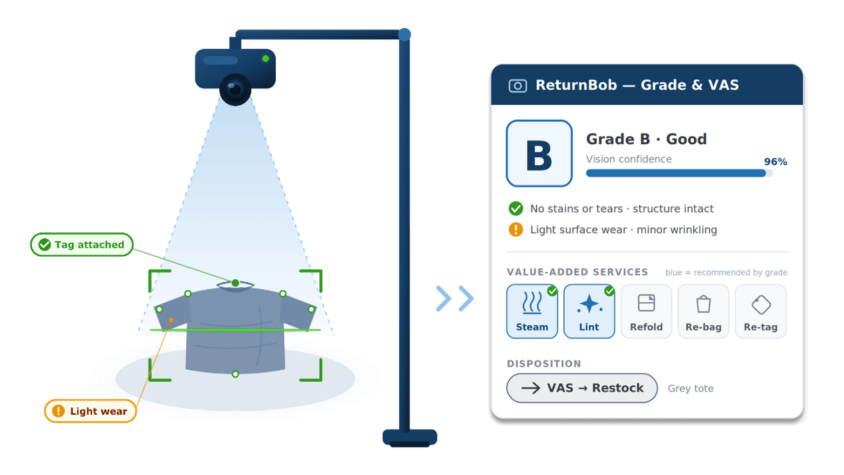
Step 3: Inspection and grading
Apparel inspection goes beyond a generic checklist. Each returned garment needs to be evaluated against the merchant’s own standards.
Inspection might include checking for stains, odors, missing tags, broken zippers, or pilling. Merchants can define up to three inspection steps to determine whether an item is fit for restocking.
For apparel brands, these inspection criteria can be configured by SKU, category, and item condition. A $120 cashmere sweater might have stricter standards than a $15 basic tee. The goal is consistent grading that matches the brand’s quality bar.
Step 4: Apparel-specific reprocessing
Once an item passes inspection, it often still needs work before it can go back on the shelf. No other product category requires as much hands-on reprocessing as apparel.
Common reprocessing steps include:
- Lint rolling to remove hair, dust, or fibers
- Rebagging in protective plastic (required for all apparel units to prevent dust)
- Retagging with fresh hang tags or brand labels
- Re-barcoding so the item scans correctly in the warehouse management system
Each of these actions is a modular service. Brands choose which ones apply to their products and pay for each service individually. A premium outerwear brand might need all four steps, but a basics brand might only need rebagging and re-barcoding.
Step 5: Disposition
Disposition is the decision point: what happens to each returned item? For apparel, there are three primary paths:
- Restock — the item is sellable and goes back into active inventory.
- Quarantine — the item is separated from sellable stock for further review or held for the merchant to retrieve.
- Disposal — the item is removed from inventory entirely.
For general returns, merchants select one of these three options based on how they want that SKU treated. For apparel returns specifically, brands can define standard operating procedures based on SKU, category, and item condition, so disposition decisions stay consistent without manual intervention every time.
Some brands also explore liquidation channels or textile recycling for items that can’t be restocked but still hold value or can be diverted from landfill.
When to move apparel returns from in-house to a fulfillment partner
Handling returns in-house works when volume is low and the process is simple. But as an apparel brand scales, returns get more complex, and the cracks start to show.
Here are common signs it’s time to explore a fulfillment partner for returns:
- Volume is outpacing your headcount. You’re hiring temp labor just to keep up with returns processing, and quality is slipping.
- Restocking bottlenecks are costing you sales. Returned items sit in bins for weeks because inspection and reprocessing take too long.
- Your team spends more time on coordination than growth. Ops leaders are managing return workflows instead of focusing on expansion or customer experience.
- You lack space or capabilities for reprocessing. Lint rolling, rebagging, and retagging require space, supplies, and trained staff that not every warehouse has.
- You’re expanding internationally. Processing returns across the US, Canada, the UK, the EU, and Australia from a single location creates long transit times and high shipping costs.
A fulfillment partner with apparel-specific returns capabilities, not just label generation, can absorb the operational complexity. That means inspection, grading, reprocessing, and restocking handled by a team that does it every day, so your team can focus on what drives revenue.
How ShipBob helps apparel brands turn returns into recovered revenue
Returns don’t have to be a black hole. With the right fulfillment partner, reverse logistics becomes a system that recovers value instead of destroying it.
ShipBob works with apparel brands to build returns workflows that fit the way they operate. Here’s what that looks like:
- Multiple clear disposition paths. Every return is routed to restock, VAS/modular refurbishment services, quarantine, or disposal based on merchant-defined configurable preferences.
- Apparel-specific SOPs. For apparel returns, brands can define standard operating procedures based on SKU, category, and item condition — so the right action happens automatically.
- Merchant-defined inspection steps. Brands set the criteria for what qualifies as restockable, and ShipBob’s teams follow them.
- Modular refurbishment services. Services such as lint rolling, rebagging, retagging, and re-barcoding. Each is priced as an individual service, so you only pay for what you need.
- All apparel bagged and barcoded. Every unit gets a protective bag and barcode, keeping inventory clean and warehouse-ready.
- Quarantine storage separated from sellable inventory. Returned items that need further review don’t mix with active stock.
- Automated return creation. Integrations with Loop Returns and AfterShip connect your returns portal directly to fulfillment. The Loop Returns integration alone has reduced the time brands spend managing returns by over 90%.
- RMA and reference ID tracking. Every return is tied to an identifier that follows it from initiation through disposition.
- Returns service-level agreement (SLA) of 10 business days. A clear timeline so you know when returned inventory will be processed and available.
- Fulfillment centers across the US, Canada, the UK, the EU, and Australia. Process returns closer to your customers, wherever they are.
Get started with ShipBob
If your apparel brand is ready to turn returns from a cost center into recovered revenue, connect with our team.
Reverse logistics for apparel FAQs
What is reverse logistics in the apparel industry?

Reverse logistics in the apparel industry covers everything that happens after a customer returns a clothing item, from receiving and inspecting the garment to reprocessing it and deciding whether to restock, quarantine, or dispose of it. How well a brand runs this process directly determines how much value it recovers from each return.
What are the main disposition options for returned apparel?
The three main disposition options are restock (return the item to sellable inventory), quarantine (separate it from active stock for further review), and disposal (remove it from inventory). Some brands also use liquidation or textile recycling channels for items that can’t be resold.
When should an apparel brand outsource returns to a fulfillment partner?
Consider outsourcing when return volume is outpacing your team’s capacity, restocking bottlenecks are causing delays, or you’re expanding into new countries and need localized processing. If your ops team spends more time coordinating returns than driving growth, that’s another strong signal.
How does reverse logistics support sustainability for apparel brands?
Effective reverse logistics keeps more garments in circulation and out of landfills. By inspecting, reprocessing, and restocking returned items efficiently, brands reduce waste. Items that can’t be resold can be routed to liquidation or textile recycling instead of disposal.
How does ShipBob handle inventory accuracy for returned apparel?
ShipBob uses RMA and reference ID tracking to match every return to its original order and SKU. Returned items go through merchant-defined inspection steps before restocking. Quarantined inventory is stored separately from sellable stock, so active inventory counts stay accurate.
What does ShipBob’s onboarding process look like for apparel brands setting up returns?
During onboarding, ShipBob works with each brand to define disposition preferences per product, set inspection criteria, and configure apparel-specific reprocessing services like lint rolling, rebagging, retagging, or re-barcoding. Brands also connect their returns platform (such as Loop Returns or AfterShip) to automate return creation.
