


Five ShipBob alternatives worth comparing are Red Stag Fulfillment, Amazon Multi-Channel Fulfillment (MCF), ShipMonk, LVK, and Shipfusion. Red Stag specializes in big, heavy and bulky products. MCF offers shared inventory for eligible FBA sellers. ShipMonk, LVK and Shipfusion offer options for complex orders, customized handling and warehouse support. Your choice depends on products, workflows and where you need inventory.
Red Stag publishes this comparison and is one of the providers covered. The recommendations below reflect our assessment of each provider’s published services.
The table below gives the short version. The sections that follow explain when each provider fits, what to ask before committing, and how to compare quotes on total cost rather than headline pick fees.
TL;DR:
ShipBob competitors worth considering

Red Stag Fulfillment offers a zero mispicks guarantee, specializing in big, bulky, and heavy products.
Amazon MCF offers shared inventory for eligible FBA sellers. Confirm packaging and channel requirements.
ShipMonk, LVK and Shipfusion offer options for complex orders, customized handling and warehouse support.
Compare providers by products, workflows, inventory locations and total cost.
ShipBob alternatives at a glance
| Provider | Worth shortlisting for | Pricing approach | Main tradeoff / check |
|---|---|---|---|
| ShipBob | Inventory storage across multiple countries | Custom quote | Confirm monthly spend and order-volume requirements |
| Red Stag | Big, heavy or bulky products; fulfillment guarantees | Custom quote | Two US hubs; small/light-only catalogs should compare economics |
| Amazon MCF | FBA sellers sharing eligible inventory across channels | Fees by size, weight, units and speed; storage separate | Confirm packaging and channel eligibility |
| ShipMonk | Multichannel brands, subscriptions, branded packouts | Custom quote; volume-based minimum | Confirm packaging charges and technology fees |
| LVK | Apparel, CPG, electronics needing customized handling | Flat rate includes one pick; storage by daily use | Overweight/fuel/dim-weight add-ons; confirm location fit |
| Shipfusion | Growing DTC brands needing lot/expiry tracking, temperature control or retail support | Custom quote | Typical client profile is 2,000+ orders/month; confirm facility capabilities |
Should you actually leave ShipBob?
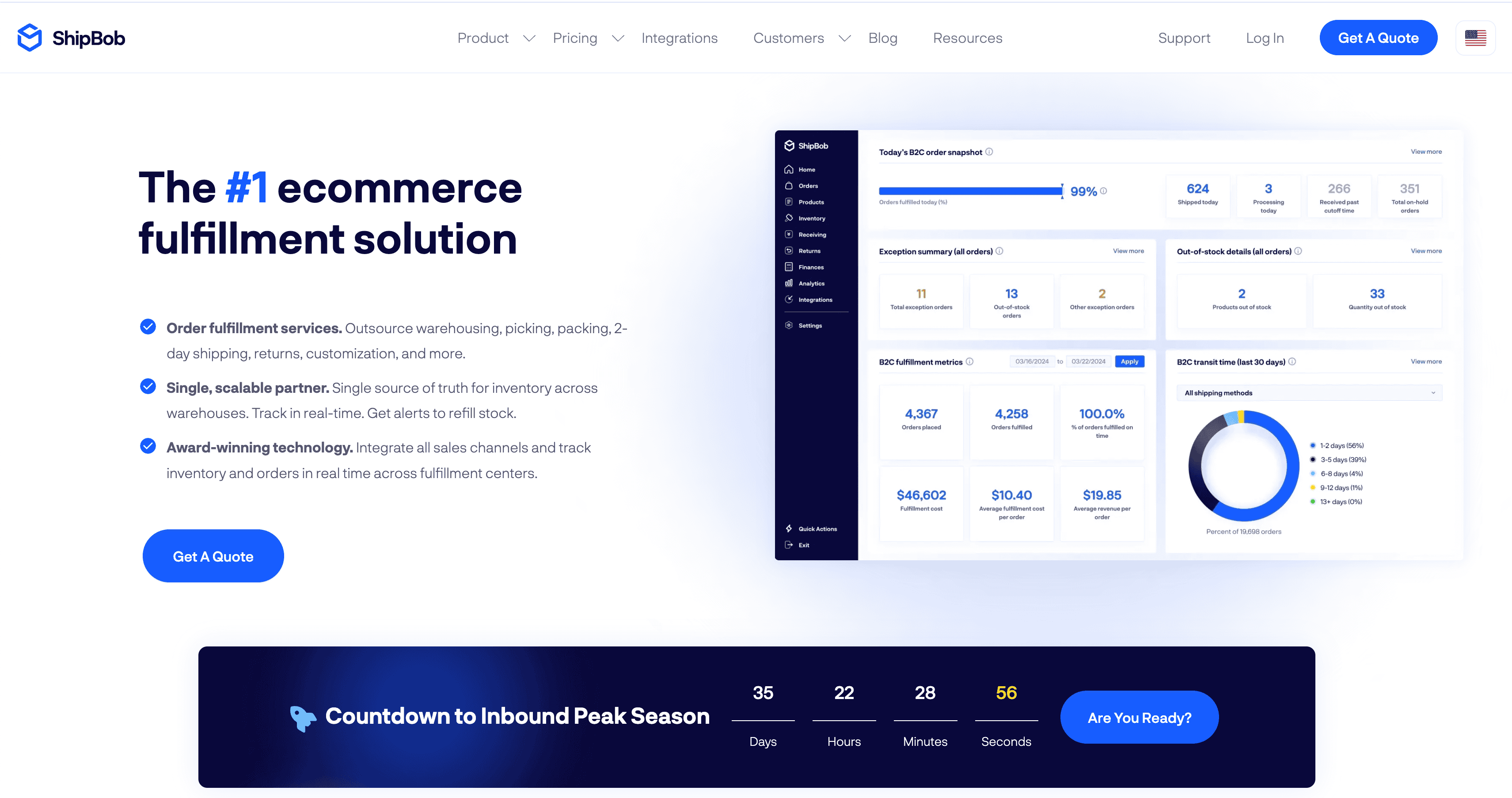
ShipBob may still fit your business. Its published footprint includes fulfillment centers in the US, Canada, the UK, Australia and Europe, which matters if you store inventory in multiple countries. Its support model offers several routes, including chat, email, a case portal and phone for urgent issues, with dedicated Merchant Success Managers for larger merchants. If your costs, handling and delivery performance meet your needs, switching may add work without solving a problem. ShipBob also publishes monthly spend and order-volume requirements; confirm the terms that apply to your account.
Several situations make it worth investigating alternatives. If your all-in costs per order have crept up and you haven’t benchmarked them against another quote recently, get one. If your products are oversized or need special handling and you’re seeing damage or handling charges, a specialist may serve you better. If issues take too long to escalate or you’re moving into retail, wholesale or new geographies that your current provider doesn’t serve well, look at providers built for those workflows.

Red Stag Fulfillment offers a zero mispicks guarantee, specializing in big, bulky, and heavy products. That’s a commitment to put mistakes right. Our guarantees page covers zero shrinkage, reimbursement of your product cost for lost or damaged inventory, shipping according to your service-level agreement, and corrective shipping costs for incorrect orders, including returning the wrong items. Same-day shipping is also available. Ask any shortlisted provider, including us, for the written definitions, exclusions, remedies and claims deadlines behind its promises.
If you ship oversized goods, our purpose-built facilities are designed for that work. We handle freight as well as parcel shipments and consult on packaging, inbound shipping and carrier options. We also handle small accessories alongside the big stuff. Pricing is custom, based on your products and fulfillment requirements.
Our U.S.-based support team has a direct line to the warehouse floor. A dedicated onboarding specialist works from a written plan for your transition. That gives you specific support arrangements to compare with the other providers’ proposals.
Red Stag also supports DTC, retail and B2B fulfillment, Amazon orders, kitting and assembly, returns and inventory planning. Our ecommerce integrations include Shopify, WooCommerce and BigCommerce, with custom API connections available. Confirm your store, retail routing requirements and inventory workflows during scoping.
The tradeoff is geography and catalog. We don’t offer in-country storage outside the US. If your catalog is entirely small and light, compare other providers’ economics before assuming ours fit. For heavy or bulky products, ask us to evaluate your packed dimensions, handling requirements and destination mix in a custom quote.
Fulfillment for enterprise & fast-growing brands

Same-day shipping available
Reach 96% of the U.S. in 2 days with ground shipping

One stop for ecommerce, DTC, and B2B/retail fulfillment

U.S. based customer support with a direct line to the warehouse floor.
Amazon Multi-Channel Fulfillment (MCF)
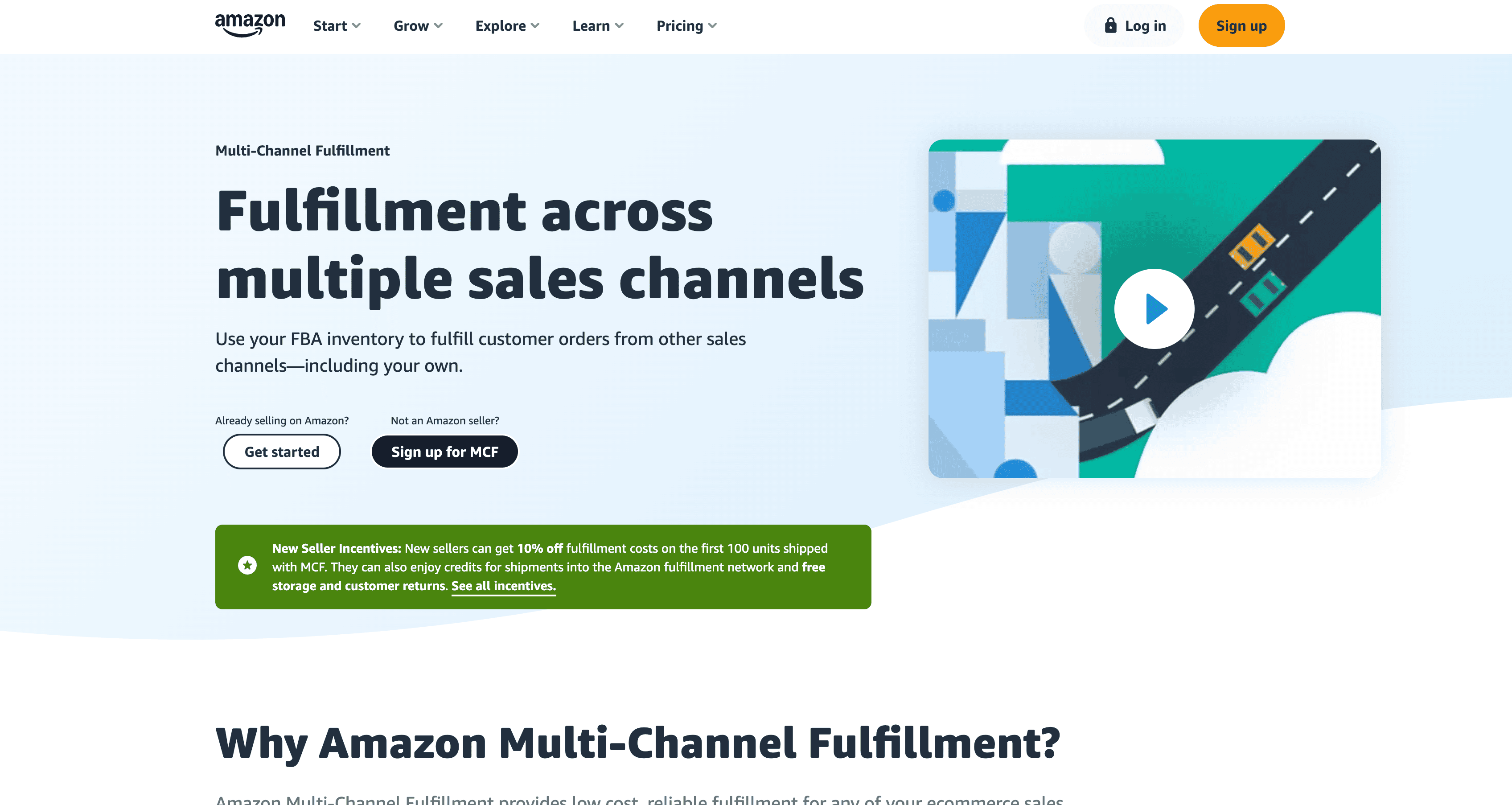
MCF fulfills off-Amazon orders; FBA fulfills Amazon orders. Consider MCF if you already use FBA and want eligible inventory to serve both channels from one stock pool.

Amazon’s MCF FAQ lists three-business-day Standard and two-business-day Expedited delivery for standard-size items already stowed in Amazon fulfillment centers, shipped within the contiguous 48 states and Washington, DC.
Amazon’s MCF pricing page bases fulfillment fees on product size, shipping weight, units per order and delivery speed. Storage is charged separately, with product type, size tier, season and utilization affecting the bill. Use the current calculator and rate card with your actual order sample before deciding whether MCF costs less.
Check packaging settings before choosing MCF. Amazon’s FAQ describes unbranded packaging, but its 2026 packaging update also allows SIPP-certified items to ship in their own product packaging by default. Packing slips are no longer included by default. Confirm your product eligibility, overbox and unbranded-packaging settings, and any channel or carrier restrictions. If branded inserts or custom packouts matter to your business, have Amazon confirm the exact workflow before moving inventory.
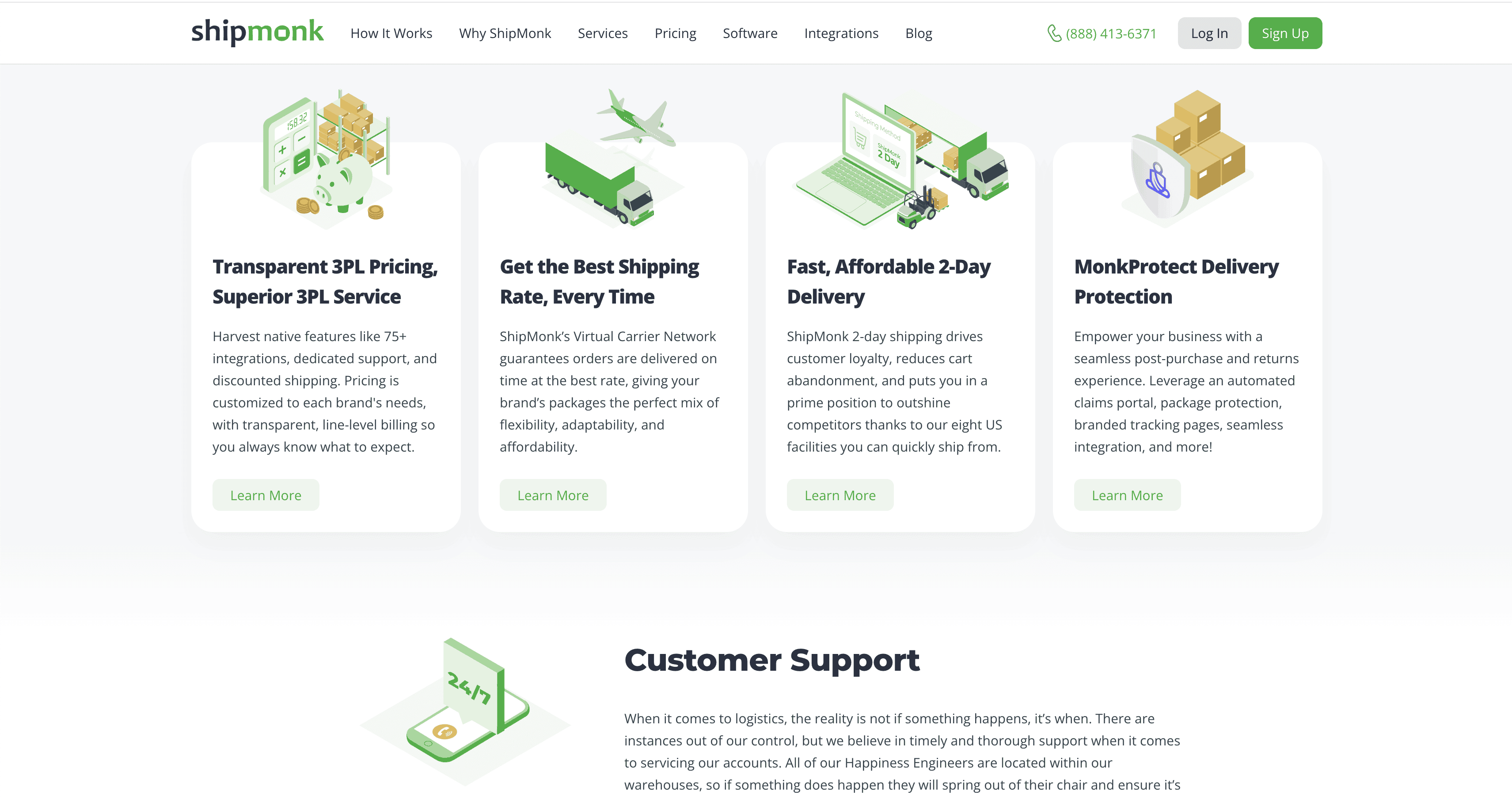
ShipMonk is worth shortlisting for multichannel brands managing high SKU counts, complex kitting and both DTC and B2B fulfillment. Its inventory and reporting tools, plus ecommerce integrations, support those workflows. Its pricing documentation also covers subscription batches, custom packaging and wholesale/EDI orders.
ShipMonk provides a custom quote, with fulfillment fees varying by volume and a monthly minimum calculated from projected volume and the first-item pick fee. The quote also outlines applicable platform, onboarding and add-on technology fees. Custom packaging counts as an additional item in pick and pack; special projects are quoted by scope, and small subscription batches can incur a setup fee.
The tradeoff is the cost of complexity. Have ShipMonk price your actual bundles, packaging and quieter months, including any minimum that still applies. All clients can access its Happiness Engineers. Ask who owns urgent issues and what response commitments your agreement includes.
If you’re weighing ShipMonk specifically against ShipBob, we have a detailed ShipMonk vs. ShipBob comparison that goes deeper than this summary.
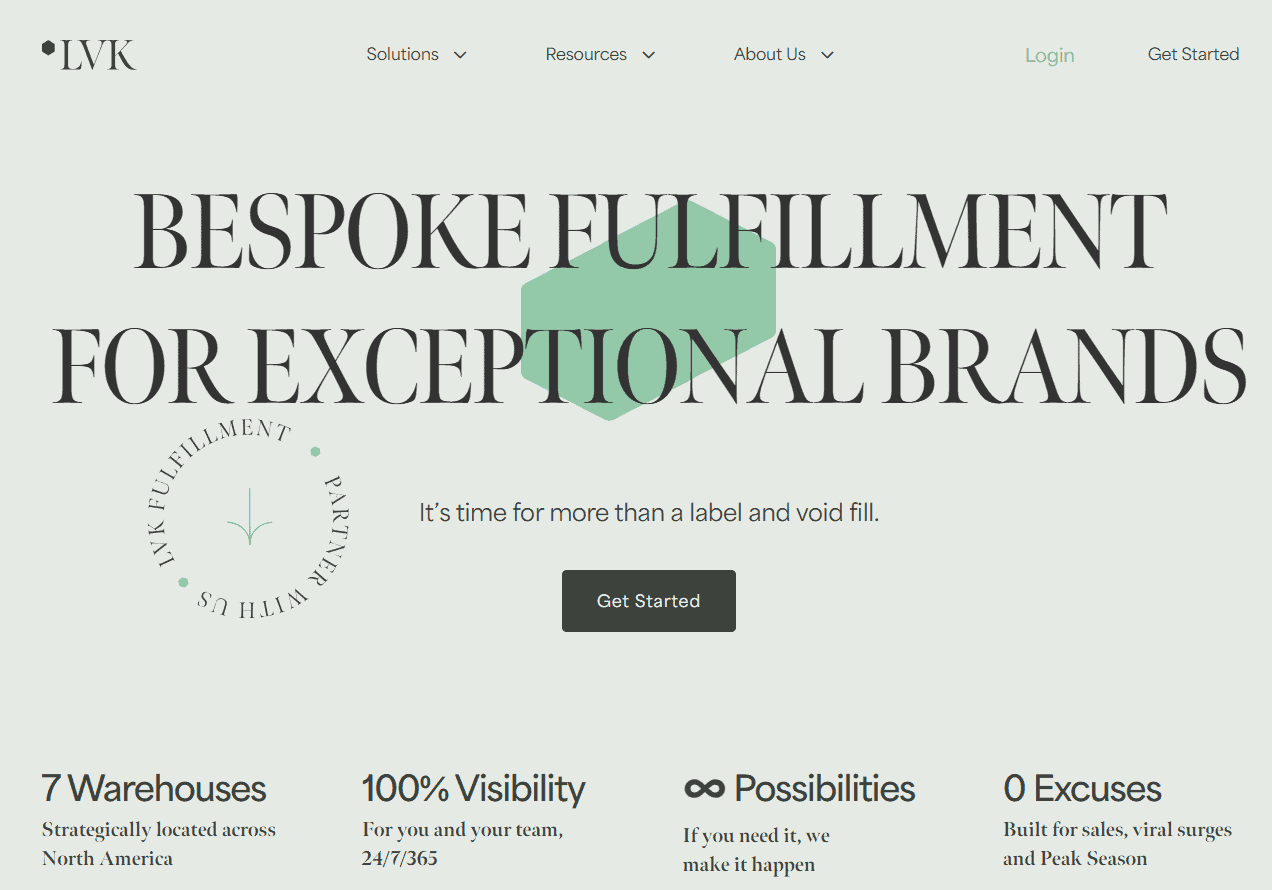
LVK is worth considering for customized handling and support from an operations team. LVK describes DTC and B2B fulfillment for apparel, consumer packaged goods and electronics, including lot and serial tracking. An account lead works with technology, support and on-site operations staff. LVK provides fulfillment, and its network runs on ShipHero warehouse management software.
LVK’s pricing FAQ describes a flat rate that includes one pick per shipment, with additional picks charged separately. Storage is based on the space you use daily. Potential add-ons include fuel, dimensional weight, hazardous materials, signature and overweight-pick charges. Include your heaviest SKUs in the quote and ask about product acceptance and shipping-service eligibility.
LVK lists facilities in the US and Canada. Ask which facility would hold your inventory and model delivery times to your customers. Flat-rate pricing doesn’t eliminate extra charges, especially for heavier or multi-item orders. Confirm support hours and escalation routes alongside the rate card.

Shipfusion is worth considering for growing DTC and retail brands that want account support at the warehouse. Its pricing page describes custom quotes based on volume, SKU count, dimensions and weights, destinations, packaging and workflows. Services include branded packaging, inserts, B2B/wholesale/EDI and routing-guide compliance. If you sell through retailers, ask how Shipfusion would handle their specific labeling, pallet and documentation requirements.
Shipfusion also lists lot tracking, expiry management and temperature-controlled storage. Those capabilities make it worth evaluating for products such as supplements, cosmetics and other temperature-sensitive goods. Confirm the temperature range, stock-rotation rules and capabilities of the facility that would hold your products. Its published fit guidance favors DTC-led brands; a primarily wholesale operation should confirm fit separately.
Shipfusion says its account managers and support team work on-site. Its current operating locations are Chicago, Las Vegas, York, Pennsylvania, and Toronto; Dallas is marked as coming soon. Check the operating network against your inventory plan, especially if you need in-country storage beyond the US and Canada.
Shipfusion says it typically works with brands shipping 2,000+ orders per month and welcomes growth plans. That’s a typical-client profile, not a hard minimum. If you’re below it, ask whether your volume and forecast fit its service model and quote. For a closer comparison, see ShipBob vs. Shipfusion.
How to compare quotes on total cost
Compare total fulfillment cost on the same order sample. A per-pick rate is useful only when you know what it includes. Request these details from every shortlisted provider:
- Receiving and put-away fees, including any per-carton or per-pallet charges
- Storage units and billing periods, including any seasonal or long-term storage charges
- Per-order and per-item charges, including extra picks for kitting and multi-item orders
- Shipping rates and surcharges, especially residential, fuel, and dimensional weight for your actual box sizes
- Packaging materials and custom packout charges
- Returns processing and special projects like kitting or subscription assembly
- Platform, integration, onboarding and monthly minimums
Give each provider the same representative sample of historical orders and inventory, including packed dimensions, weights and destinations. Ask for ordinary-month, peak and low-volume scenarios. Separate recurring charges from one-time costs, and have each provider explain assumptions and excluded services. Use the resulting totals to compare cost per order at each volume level.
Our guide to 3PL pricing explains the common fee categories. Use provider quotes for your decision; market benchmarks are not offers for your account.
Compare service definitions too: when the shipping clock starts, receiving cutoffs, order-accuracy measurement, escalation contacts, exclusions, remedies and claims deadlines. For fragile or high-value products, ask how packaging is tested and damage claims are handled. We haven’t reviewed competitors’ private agreements. Ask every provider for commitments in writing.
A switching sequence that protects you
Plan inventory availability and order routing before transferring stock. A small pilot can uncover mapping, packaging or receiving problems while you still have a fallback.
- Review your current contract’s exit terms and inventory removal costs before signing anything. Add one-time transition costs to your switching math: freight to move inventory, storage you’ll pay at both providers during the overlap, and integration work. Keep these separate from recurring cost comparisons.
- Map your SKUs, integrations and any special handling to the new provider, and agree receiving schedules, support contacts and service levels in writing.
- Pilot if both providers support the arrangement. Send a small, representative batch of inventory and test single-item orders, bundles, special packaging and a return where relevant. Check accuracy, inventory updates and communication. Plan for stock that may be unavailable while in transit or awaiting receipt, and avoid peak season if possible.
- Reconcile stock counts, test routing and prevent duplicate fulfillment before increasing the share of orders sent to the new provider.
- Agree a fallback and exit schedule that your contracts allow. Where feasible, keep the existing arrangement available until the pilot meets your acceptance criteria.
A realistic timeline depends on your catalog, integrations, receiving capacity and seasonality. Ask who owns the transition plan and what must pass before you move the remaining inventory.
FAQs

What is the difference between Red Stag Fulfillment and ShipBob?
Red Stag specializes in big, heavy and bulky products, with two US warehouse hubs, U.S.-based warehouse support and written fulfillment guarantees. ShipBob offers inventory storage across multiple countries. Shortlist Red Stag for its handling specialization and accountability; consider ShipBob’s footprint if you need stock held closer to customers abroad. Compare quotes and service agreements using the same products, destinations and order mix.
Should I choose Amazon MCF instead of ShipBob?
MCF is worth comparing when you want eligible FBA inventory to fulfill off-Amazon orders from the same stock pool. You don’t have to sell on Amazon to use MCF. If your decision depends on custom packaging, inserts or special handling, ask both providers to demonstrate those workflows. SIPP product packaging and an unbranded outer box are different options; neither by itself confirms support for your preferred custom packout.
What is the cheapest ShipBob alternative?
There’s no universal cheapest option. Every provider prices by your products, volumes and destinations. Get quotes from two or three on the same order sample, including storage, surcharges, packaging and minimums, and compare total monthly cost rather than pick fees.
Do these alternatives work for small businesses or low order volume?
Confirm minimums and eligibility directly with each provider. ShipBob publishes monthly spend and order-volume requirements; ShipMonk calculates a minimum using expected volume. Don’t treat missing public minimums as evidence that none apply. Compare projected costs at your current volume and during a quiet month before choosing.
Is LVK the same as ShipHero?
LVK provides outsourced fulfillment, and its network uses ShipHero warehouse management software. Those are different services to evaluate: buying software to operate a warehouse is different from hiring a provider to store inventory and ship orders. Confirm which service you need when requesting a demo or quote.
Sources and method
We checked provider documentation on September 16, 2026, including the pages linked above. Best-fit labels are Red Stag editorial judgments, not provider-stated rankings, and we did not conduct comparative operational testing of any provider. Exact pricing and service commitments are governed by each provider’s quote and agreement.
Is Red Stag the right ShipBob alternative for you?
If you ship big, heavy or bulky products, request a Red Stag quote. Bring your packed product dimensions and weights, average monthly order volume, primary destinations and special handling needs. That gives our team the details to assess fit and build a proposal around your actual operation.
