

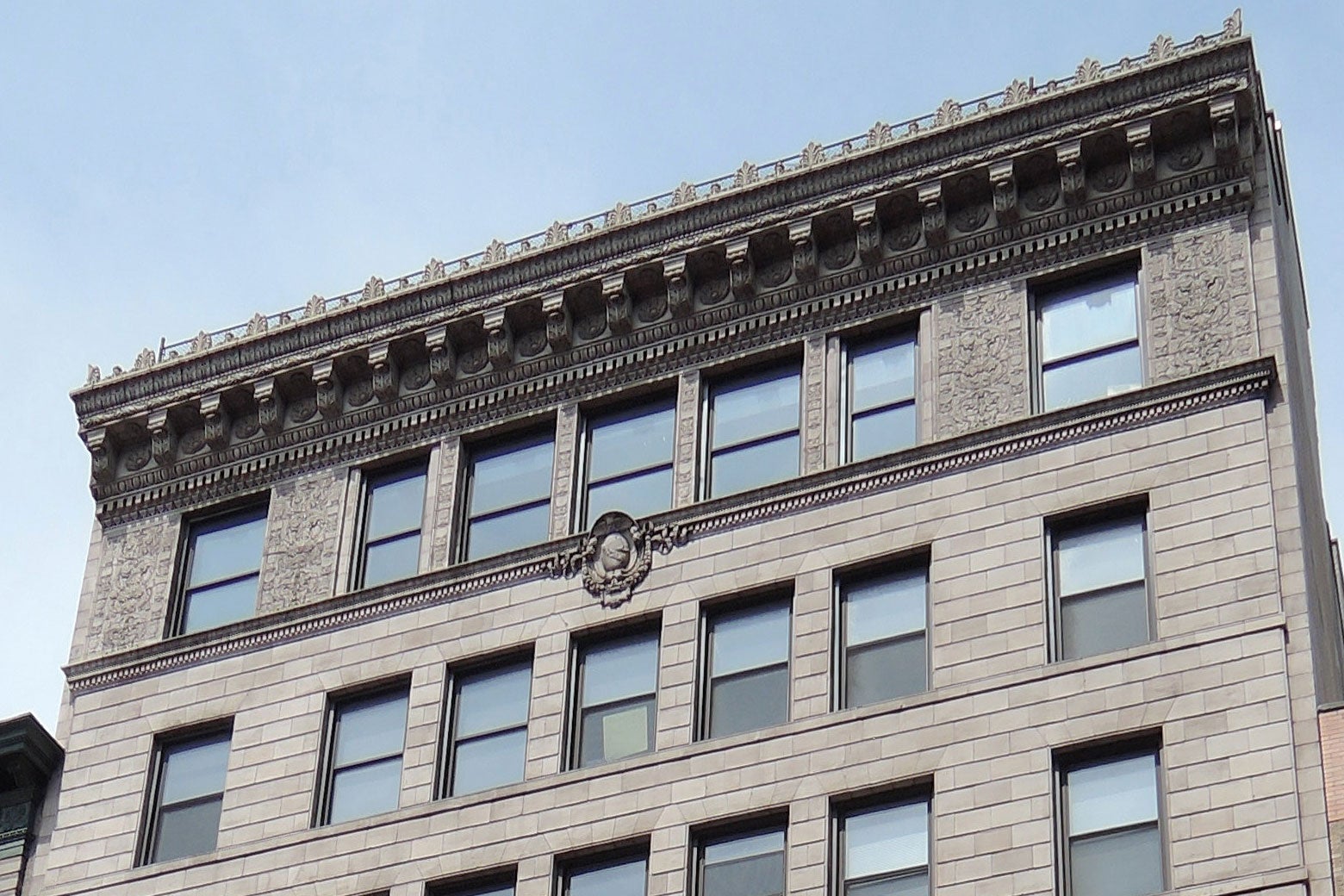
The facade of the building betrays no affiliation—neither hammer nor sickle.
At 235 W. 23rd St. in Manhattan, the lobby is similarly spartan. All the signage is in black and white, the walls various shades of gray. A private equity firm resides on the fifth floor; an A.I. firm takes up the penthouse property on eight. The third and fourth floors have tenants as well. The directory says that on the seventh floor, there is the building’s management company, an education company, two publishers, and something else: the “Offices of the CPUSA”—that is, the headquarters of the Communist Party USA.
On the occasion of America’s 250th anniversary, President Donald Trump took time away from the birthday revelry to warn of a grave and imposing adversary. “Communism is a mortal threat to American liberty. It is the greatest threat to our country, including World War I, World War II, Pearl Harbor, or even 9/11,” he said on July Fourth weekend this year, in South Dakota. That’s an awfully big threat, you might think, but the president is way ahead of you. “I think it’s the greatest threat that I’ve ever seen to our country,” he told a Georgia audience a few days before.
In fact, according to the Atlantic, Trump mentioned communism or communist 15 times on that Georgia soapbox, “starting less than a minute into his hour-plus speech.” All summer long he’s been worked up, not over the Antifa anarchists or the DSA socialists but the commies in particular. He’s not alone. Secretary of State Marco Rubio is also riled by the Red hunt—he’s been convening politicians and law-enforcement officers and counterterrorism experts from around the globe to combat the “transnational threat.” And recently confirmed Secretary of Homeland Security Markwayne Mullin has seen the communists on our very own liberty-loving shores. He went on Fox News with a big-time scoop: He had identified the Communist Party logo on a “No Kings” rally flyer. “No Kings Rally is literally sponsored by the Communist Party,” he ascertained.
Red Scare politics are back, about that there is no question. But where, exactly, are those scary Reds who have infiltrated and organized and outflanked the administration? Certainly, it seems, they are everywhere. But individually, they are extremely difficult to find. They are not doing high-profile sabotage of corporations; they are not shooting it out in the coal mines. One place they definitely are, though, is in this building in Manhattan, right out there in the open for anyone to see. And so, on a late morning in late August, I buzzed the seventh floor and rode the elevator straight into the belly of the beast.
In the middle of the CPUSA office, sitting at a table in a conference room with four walls of glass, was Joe Sims, the party’s co-chair, wearing a black newsboy cap. In front of him stood a walker. Across the table was another comrade, youthful office assistant Brooklyn Crawford. Usually, it would be slightly more bustling than this, Sims assured me. But, as it was late August, these were the only two people in the office, save for the odd delivery guy, dropping off a package.
Already, this was a deeper trip into the inner sanctum than anyone in the Trump administration had managed. CPUSA co-chair Sims told me that despite the president’s pugilism, there had not yet been any Justice Department demands, nor congressional subpoenas, nor even right-wing agitators out front. “It’s not a crime to be a Communist in this country,” he said.
Around the office were vestiges of times gone by. The walls were decorated with a framed cartoon of Josef Lenin sweeping kings and capitalist fat cats from the Earth, and a charcoal drawing of a man with a mallet pointing to a bullseye reading “$60,000,” part of a onetime fundraising drive. There was a stylized poster of Che Guevara celebrating a little-known holiday on Oct. 8—Day of the Heroic Guerilla.
Elsewhere, Soviet realist–style paintings hung. Gifts from Cuba, a plate from the Communist Party of Vietnam (given “with compliments”), and various statuettes and busts adorned the countertops and bookshelves. Framed photos of bygone leadership. There was a small kitchen, with a sign taped to the fridge: “Please clean up after yourself no maid service here!!!” Out of the back windows was a view of the Edge NYC, the flagship high-rise property of Hudson Yards, with its protuberant observation deck. Out of the front windows was the distinctive facade of the Chelsea Hotel.
The office, Crawford told me, had been designed for transparency and decked out with sustainable materials: bamboo, linoleum tables made from linseed oil, recycled carpeting, and the glass-walled conference room, all in service of an environmentally aligned approach.
I settled into a chair between comrade Sims and comrade Crawford, and asked them about the party’s political program, the path toward revolution—a winding path, no doubt, but one that has required incredible endurance. The party has survived the Red Scare of the 1950s, the Cold War, and the Soviet collapse, and is somehow over 100 years old. And now, they ae readying another Red Scare.
Let’s get this out of the way quickly: The USA Communist Party, contra Trump and Co., is not a major player in American politics these days, behind the scenes or out front. It works with local tenants’ groups, it boosts candidates, it piggybacks on the Democratic Socialists of America sometimes, but sometimes not. Its numbers have grown over the past decade, but not overwhelmingly.
But arguably more important than the art collection or the political strategy, and perhaps more important even than the dues collection, in explaining the Communist Party’s unlikely longevity, is the building we were in itself.
Because the CPUSA is not merely a tenant holding down an office on a surprisingly posh block of Manhattan’s very gilt-edged neighborhood of Chelsea. The CPUSA is the owner of the office. In fact, the Communist Party is owner of the entire building at 235 W. 23rd St., a flagship commercial property now valued at nearly $10 million. And one of the party’s essential functions at the moment, as it has been for the past 20 years, is something Trump could well understand: It is a commercial landlord, collecting rents from commercial tenants on the building’s other floors. The Communists and the president, those bitter adversaries, might have more in common than they think. But unlike Trump, the Communists really, really hate talking about it.
The story of the CPUSA cannot be told without getting into the quirks and particularities of Gus Hall.
Hall was first elected secretary general of the party in 1959, a title he held until his death in 2000. Hall ran for president (of the United States) four times: twice in the 1970s, twice in the 1980s. His best finish came in 1976, when he netted just shy of 59,000 votes, though the exact count is contested. He was the genuine artifact, the son of an impoverished Minnesota miner; a lumberjack and a steelworker in his youth.
Hall led the party through the exceedingly challenging times of the Cold War era, the aftermath of McCarthyism, and the subsequent collapse of the Soviet Union. In some sense, it is a miracle that the party survived, though it has held on in a deeply diminished fashion.
Although Hall long maintained that the CPUSA was a fully independent entity, a Moscow newspaper reported in 1992 that Hall had been the recipient of $40 million in Soviet assistance between 1971 and 1990.
“The struggle between those who own the wealth and those whose labor produces the wealth is one flaw in capitalism that will lead to socialism,” Hall said in 1996.
And Hall took his own sermonizing to heart. In the late 1970s, during that period of Soviet patronage, Hall decided to get into real estate. He purchased the building on 23rd Street, according to public records, in the 1970s, taking out a $150,000 mortgage on the property at an 8 percent interest rate.
That wasn’t his only shrewd money move. There were other properties Hall and the party owned, too. Sims, meanwhile, told me that Hall also got the party into the stock market. Even in the 1970s, Hall had a reputation for “playing around with stocks,” Sims said. Under the leadership of Hall and national Chairman Henry Winston, the party raised capital funds from comrades, which were then invested. So while his politicking may have left something to be desired—the party bled membership while he celebrated North Korea and various Stalinist ideas—his asset accumulation proved visionary. “We have investments,” Sims told me, declining to further elaborate on the portfolio.
For a long time, the CPUSA occupied the entire Chelsea building, despite a dwindling headcount. And when the 1907-built edifice required maintenance, some party members did not view it as a blessing.
In a September 2001 report to the board, a year after Hall’s death, the party took stock of its holding. “Our building is a wonderful asset, a real treasure for our Party and the working class movement of which we are all immensely proud. It’s situated in a prime location, midtown Manhattan, worth million[s] in today’s market.”
But having five-digit annual operating expenses “puts a tremendous burden on Party finances,” the report found. “You often hear that the building has a shabby appearance. Unfortunately we would have to admit this is all too true. The reality is we can’t keep on top of it. The building has been under capitalized for years.”
Finally, the report resolves: Though the party “still [has] to be alert to the enemy,” “the decline in anti-communism has created new opportunities to utilize our building in a new way.” In other words: to lease it out. And so the revolutionaries became rent-seekers.
Hall once famously said he was forced to buy his home in Yonkers—under his wife’s name, in 1960, for $21,000—because no landlord “would rent to a Communist leader.” Now, the Communists were on the other side. By 2007, they were in the process of withdrawing from eight to four floors, after having spent $1 million on renovations, and renting the other four out. By 2026, they had vacated seven of eight.
On the seventh floor, the new Red Square had not quite arrived. But it is worth being clear that this is not simply White House bluster, or Fox News filler. Republicans in Congress, on the Ways and Means Committee, have subpoenaed various left-wing groups as part of an investigation into foreign funding linked to the Chinese Communist Party.
But that dogged search for connections to the Chinese Communist Party has not led Republicans to the American Communist Party. “So far, thankfully, no,” Sims said. “As long as we pay our taxes, pay our electrical bill, I think we’re OK.”
“We have what we call fraternal ties with other Communist Parties, but we don’t have any economic relationships. Nor do these other groups, by the way.”
So what are these communists plotting?
When Vermont Sen. Bernie Sanders sparked the left-wing reawakening, in 2016, the CPUSA membership was nearly even with that of the fledgling Democratic Socialists of America, both sleepy holdovers of a bygone political moment. According to Gus Hall’s obituary in the New York Times in 2000, Communist Party enrollment “had dwindled to about 3,000, down from a peak of about 66,000 in 1939.” In 1962, a full 17 percent of the membership was reported to be federal informants.
“Since 2016, we’ve recruited 20,000 people that have applied for membership in the party,” Sims told me, though the party has long suffered from overstatement when it comes to self-reported membership numbers. “I think about 4,000 people have joined since 2022,” he added, a more modest addendum. According to the party’s website, about a third of those pay dues.
But even if that’s a generous figure, it’s paltry compared to the growth of Democratic Socialists of America over that same time period. In a decade, the DSA has gone from roughly 6,000 members to 120,000, marking some of its biggest gains in the past year or so. “I’m jealous,” Sims said.
Critically, DSA doesn’t just have members, it also has elected officials. At last count, there were six DSA members in the New York state Assembly, three DSA state senators, and four DSAers on the New York City Council. Bigger, perhaps, than all is the New York City mayor’s mansion, where Democratic Socialist Zohran Mamdani resides. And that’s just in New York: Soon, there will likely be DSA-affiliated members of Congress from Colorado, Pennsylvania, Michigan, and more.
That is high on the to-do list for the CPUSA. “We got away from running candidates in the 1980s,” Sims told me. “That’s something we’d like to get back to.”
“If we were to win an election, in a major city, or even in a midsize city … it would’ve been on the front page of the New York Times. It’s one thing for a Socialist to win, but for a Communist, oh my God,” he said.
Running candidates is not the only area in which the group differs with the DSA, despite the shared affinity for the color red. On some issues there is agreement, and the two groups work in coalition. “Not an ideological configuration, but a practical one,” said Sims. DSA groups sometimes come and use the office when there is strategic alignment and a need for a venue.
But not always. “On some things we don’t agree, like on housing. We’re for public housing. They’re for a scheme which goes in the direction of privatization,” said Sims, referring to RAD/PACT, a policy supported by the mayor that would see Section 9, or traditional public housing, converted to Section 8, which the city owns but doesn’t directly fund or manage.
Another point of difference would be the property itself. While property ownership has been a controversy-causer in DSA of late—the New York Post has sought, perhaps effectively, to gin up outrage over DSA co-chair Gustavo Gordillo’s ownership of a Brooklyn home purchased by his parents—the CPUSA is not losing sleep over implications of hypocrisy with regard to its own property ownership.
“People outside of leftist spaces will be like, ‘How do you call yourself a Communist—you have an iPhone.’ We all live in a society where we’re trying to live and survive and participate,” said Crawford.
For now, the party sees the Republican Party in a creep toward fascism, and forestalling that is a top priority. As such, the Communists remain interested in helping Democrats win elections. That means voter turnout, and coalition-building on certain issues. “We’re not so much interested in a Democratic victory for its own sake, but we’re for pushing back that danger as much as possible. We live in the real world, and in the real world there are differences between the two parties on issues that affect working people,” Sims said.
A Democratic majority in the House would, among other things, probably cool off the Red Scare redux. “The Democratic Party, though it has a lot of weaknesses, they haven’t joined the choir,” he said. Flipping the House to a Democratic majority would get the gavel away from Republican Ways and Means Committee Chair Jason Smith, and put an end to his Joe McCarthy impression.
This office, though quiet on this Thursday, does get used—it is not just “a museum of history,” as Gus Hall used to call it. The Young Communist League meets there; some tenant groups from local public housing units will gather there as well. The party continues to publish People’s World, the publication once (and perhaps better) known as the Daily Worker. Is the publication primarily funded by rents raised from the office building? I asked.
“You keep coming back to the building,” Sims said. “No.”
It’s true—I kept coming back to the building. I couldn’t help it. A website mocked up by commercial real estate brokerage RDE Advisors celebrates its many advantages. “12’ ceilings throughout, with a spectacular 16’ ceiling penthouse on the 8th floor,” it reads.
“Roof deck potential,” it adds.
“What could 235 W. 23rd become?” asks another part of the site. “AI Tech Headquarters” and “Fashion Agency” are among the suggestions.
The building boasts 55,362 square feet of rentable space, roughly 6,766 per floor. The site claims that all of the floors are vacant/available or soon will be, including the Communist Party’s seventh, which is not correct. The asking price—$39 per square foot, per year—looked like a bargain when compared cursorily to other available office space in the neighborhood listed online.
“This is one of the few remaining opportunities in Manhattan to consolidate your entire organization under one roof,” the site says. “The landlord will consider leasing floors individually.” Crawford, the assistant, clarified to me that they would rent to most people, “though we wouldn’t rent to Turning Point USA.”
The leasing agents didn’t respond to my requests for comment. I reached out to all of the tenants as well, to ask what it was like to have the Communist Party as a landlord.
Only Ross Cameron, co-founder of Lyric Capital Group, a private equity firm focused on music royalties, housed on four, responded.
“This email made me laugh out loud! Didn’t know there was a connection with the owner to the Communist Party and honestly didn’t know there was still an American Communist Party!” he said.
