
Should you sell internationally on Amazon vs own website? Picture a buyer in Toronto searching for a hand-block-printed cotton kurta. They could find yours on Amazon.ca, or they could land on your Shopify store from an Instagram ad. It’s the same product made by the same team in Jaipur, but the two orders behave very differently once you look at the economics.
That’s the real question behind this choice. It isn’t about which channel is “better”. It’s about which one fits your product, your budget and the stage your business is at.
This guide compares both routes on what actually moves your margins: customer acquisition, fees, brand control, data, fulfilment, delivery, returns and day-to-day effort. You’ll also get a decision matrix and worked examples to help you choose.
Amazon Global Selling vs Your Own Website: The Short Answer
If you need demand fast and don’t have an overseas audience yet, a marketplace is usually the easier start. If you already have loyal customers abroad, or a brand people search for by name, your own website lets you keep more of the relationship.
Here’s how the two compare at a glance.
| Factor | Amazon Global Selling | Your own international website |
|---|---|---|
| Customer acquisition | Built-in shoppers, but you compete for visibility | You pay for every visitor through ads, SEO or social |
| Fees | Selling plan, referral fees and optional fulfilment fees | Platform subscription, payment gateway fees and apps |
| Brand control | Limited to Amazon’s listing formats and policies | Full control over design, content and offers |
| Customer data | Amazon owns the customer relationship | You own emails, order history and remarketing lists |
| Fulfilment | Ship from India yourself or use Amazon’s fulfilment | Ship from India or use your own overseas 3PL |
| Returns | Follow Amazon’s return policy for each marketplace | You set your own returns policy |
| Complexity | Lower to start, rules to follow | Higher to start, more freedom |
The rest of this guide explains each row, so you can weigh them against your own numbers.
How Selling Internationally on Amazon Works
Amazon Global Selling lets Indian sellers list on 18+ Amazon marketplaces, including the US, UK, Canada, UAE, Germany and Saudi Arabia. The process has four steps: register a seller account, list your products, ship to customers, and receive payments in INR in your Indian bank account.
You’ll still need your export basics in place. That means GST registration, an Import Export Code (IEC) and proper export documentation for each shipment. Our full guide to Amazon Global Selling covers registration in detail.
What you pay on Amazon
Amazon’s fees fall into three groups:
- Selling plan fee: a monthly subscription for a professional account in each region.
- Referral fee: a percentage of the sale price, which varies by category and marketplace, with a minimum per item.
- Fulfilment fees: only if you use Fulfillment by Amazon (FBA). These cover picking, packing, delivery and storage.
Amazon publishes fee tables for each region on its Global Selling page for Indian sellers. Always check the current table for your category before you price a product, because rates change.
Marketplace fulfilment options
You have two main ways to fulfil Amazon orders abroad:
- Merchant Fulfilled Network (MFN): you ship each order from India to the buyer using your own courier partner.
- Fulfillment by Amazon (FBA): you send stock to Amazon’s fulfilment centres in the destination country, and Amazon delivers to buyers. Amazon’s SEND programme can move that inventory from India to its fulfilment centres, with the partner carrier handling customs.
We look at the trade-offs between these two models later in the guide.
How Selling From Your Own International eCommerce Website Works
With your own international eCommerce website, you run the storefront yourself, usually on Shopify, WooCommerce or a similar platform. Buyers pay through an international payment gateway, and you ship the order from India or from overseas stock.
The setup is more hands-on. You need:
- A store with prices in local currencies and shipping rules for each country.
- A payment gateway that accepts cards and wallets abroad and settles to India. See our sister blog’s roundup of the best international payment gateways.
- A plan for duties and taxes, such as charging import duty at checkout and shipping duty-paid.
- A marketing engine, because no one finds a new store by accident.
Tax rules can also apply to you directly. For example, overseas sellers who sell goods worth £135 or less straight to UK consumers must account for UK VAT at the point of sale, according to GOV.UK guidance. On a marketplace, the platform often handles this collection for you.
This is the cross-border D2C model. It takes more work, but every order builds your brand rather than a marketplace’s. For a broader view of owning a store versus listing on one, read our comparison of an eCommerce platform vs marketplace.
Amazon vs Own Website: 8 Factors Compared
1. Customer acquisition
Amazon brings shoppers who are already searching to buy. Your job is to win the search results and the Buy Box, which often means spending on sponsored ads as competition grows.
On your own site, traffic is your problem from day one. Paid social, Google Ads, influencers and SEO all cost money or time. The upside is that a customer you acquire once can buy again without another marketplace fee.
2. Marketplace fees vs website costs
Marketplace fees scale with every sale. Website costs are mostly fixed, such as platform plans and apps, plus a payment gateway charge on each order.
So the cost question really becomes: is your referral fee per order higher or lower than your cost of acquiring a customer on your own site? For many new brands, a referral fee is cheaper than paid ads. For brands with strong repeat buyers, the website often catches up over time.
3. Brand control
Amazon standardises how listings look. You get titles, images, bullets and, if you’re brand registered, richer content, but the page is still Amazon’s.
Your website lets you tell the full story: how the product is made, who makes it and why it’s different. That matters for crafts, wellness, fashion and other categories where the brand story drives the price.
4. Customer data
This is often the deciding factor. On Amazon, you get order details for fulfilment but limited ways to contact buyers for marketing. On your own site, you own emails, phone numbers, purchase history and browsing behaviour.
That data powers repeat sales, loyalty programmes and lookalike audiences. A marketplace customer is rented. A website customer is yours.
5. Fulfilment requirements
Amazon sets clear rules on handling time, tracking and delivery promises, and your seller metrics suffer when you miss them. FBA has its own rules for labelling, packaging and inbound shipments.
On your own site, you set the promise. But you still need reliable international shipping, accurate customs paperwork and tracking your buyers trust.
6. Delivery expectations
Shoppers on large marketplaces are used to fast, predictable delivery. If you ship each order from India, a delivery window measured in days to a couple of weeks can hurt conversions next to locally stocked competitors.
Buyers on a brand’s own site are often more patient, especially for handmade or unique products. Setting clear expectations at checkout and offering duty-paid shipping helps a lot.
7. Returns
Amazon’s return policies are buyer-friendly, and you have to follow them in each marketplace. Returning an item to India can cost more than the product itself.
On your own site, you write the policy. Many Indian sellers offer refunds or replacements without asking for low-value items back. Our guide to returns management in cross-border shipping explains the common setups.
8. Operational complexity
A marketplace is simpler to start. Payments, storefront, trust and often tax collection are handled for you.
A website asks more of you: tech, payments, tax, customer service and marketing. In return, you get freedom to run your own offers, bundles and subscriptions.
Ship From India or Stock Overseas? Two Fulfilment Models
Whichever channel you choose, you also need to decide where your inventory sits. This choice shapes delivery speed, cash flow and risk.
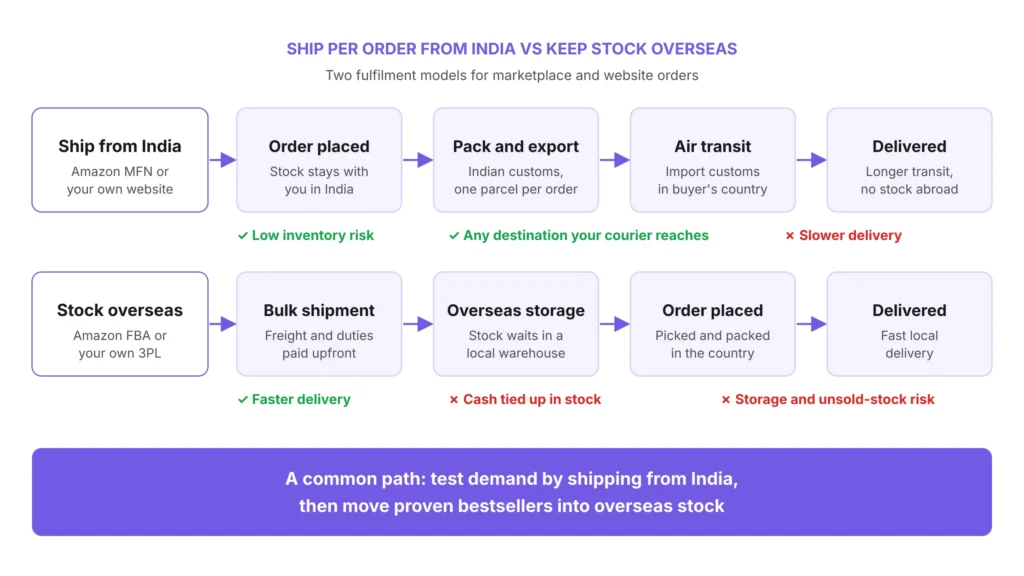
Shipping each order from India
Every order leaves India as its own export parcel. It goes through export customs here, travels by air and clears import customs in the buyer’s country.
This model works for both Amazon MFN and your own website. Its biggest advantage is low risk: you don’t pay for stock until it sells. It suits new exporters, wide catalogues and products with uncertain demand. eCommerce exports by courier are cleared under Courier Shipping Bills, and our guide to CSB-IV vs CSB-V explains which form fits commercial orders.
Keeping stock overseas
Here you send inventory in bulk to a warehouse in the destination country, either Amazon’s fulfilment centres through FBA or your own overseas 3PL. Each order then ships locally, so delivery is faster.
The trade-off is cash and risk. You pay freight, duties and storage upfront, and unsold stock is expensive to bring back. Our guide on Amazon FBA exports to the USA from India covers the inbound process.
A common approach is to ship from India while you test demand, then move proven bestsellers into overseas stock.
Illustrative Example: How One Order’s Economics Change by Channel
Let’s follow one order to make this concrete. The numbers below are illustrative assumptions, not actual Amazon fees or courier rates. Replace them with your own quotes before you decide anything.
Say you sell a cotton kurta to a buyer in the US for the equivalent of ₹3,000. It weighs about 500 g when packed.
| Cost per order (illustrative) | Amazon, ship from India | Amazon, stock overseas | Own website, ship from India |
|---|---|---|---|
| Referral or payment fee | ₹450 (15% referral) | ₹450 (15% referral) | ₹90 (3% gateway) |
| Shipping | ₹1,200 parcel from India | ₹650 fulfilment fee plus inbound freight share | ₹1,200 parcel from India |
| Customer acquisition | ₹150 sponsored ads | ₹150 sponsored ads | ₹600 paid social |
| Channel and delivery cost | ₹1,800 | ₹1,250 | ₹1,890 |
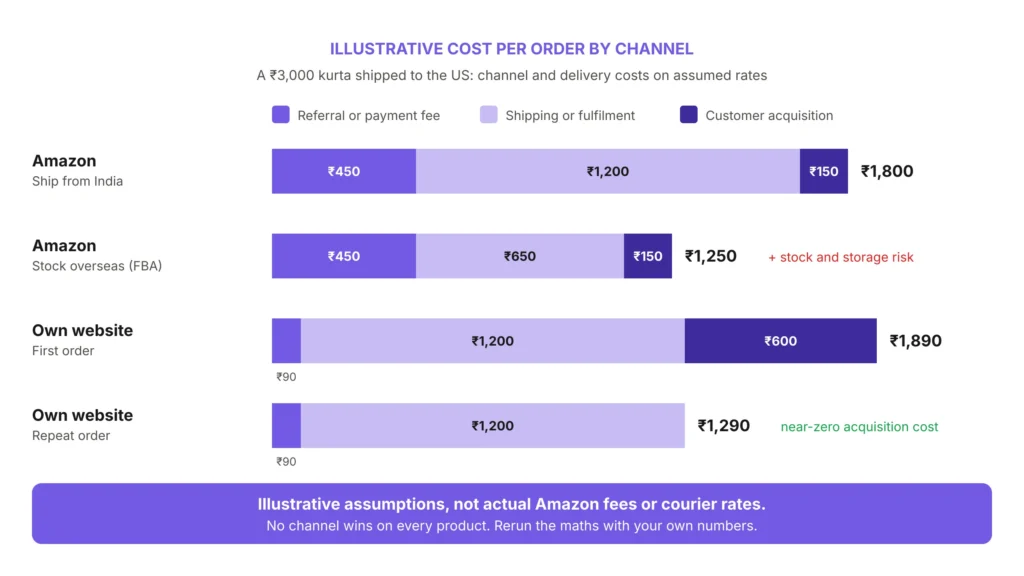
On these assumptions, the website looks most expensive for a first order. But look at what happens when the same buyer comes back. On a repeat purchase driven by email, your acquisition cost on the website drops close to zero, so the channel and delivery cost falls to about ₹1,290. On Amazon, you pay the referral fee again on every order.
The overseas stock option looks cheapest per order. But it ignores what you’ve tied up in stock, storage fees and the risk of unsold units. If only half the stock you send sells, the real cost per sold unit rises sharply.
The takeaway: no channel wins on every product. Run this table with your own landed cost, real fee tables and real acquisition costs.
How Shipping Arrangements and Destination Coverage Shape the Choice
Your logistics setup can quietly decide the channel for you. Here’s what to check.
Destination coverage. Amazon only lets you sell where it has a marketplace you’re eligible for. Your own website can sell to almost any country your shipping partner reaches. If your demand is in markets without an Amazon store, the website wins by default.
Duties and who pays them. Surprise import charges at the door lead to refused parcels and returns. The US suspended its $800 de minimis exemption for all countries from 29 August 2025, so even small parcels can now attract duty. Delivered Duty Paid shipping lets you collect duty upfront. Our guide to DDP for USA shipments explains how it works, and our list of de minimis values by country helps for other markets.
Delivery speed per lane. If your shipping partner can reach a market in a predictable window, shipping from India can work well for your website. For Amazon marketplaces with very fast delivery norms, overseas stock may be needed to compete on bestsellers.
One setup or two. If you plan to run both channels, pick a shipping partner that can take orders from your marketplace accounts and your website in one place. Otherwise, you’ll end up running two separate operations.
Decision Matrix: Which Channel Fits Your Business?
Use this matrix as a starting point. Your own numbers should have the final say.
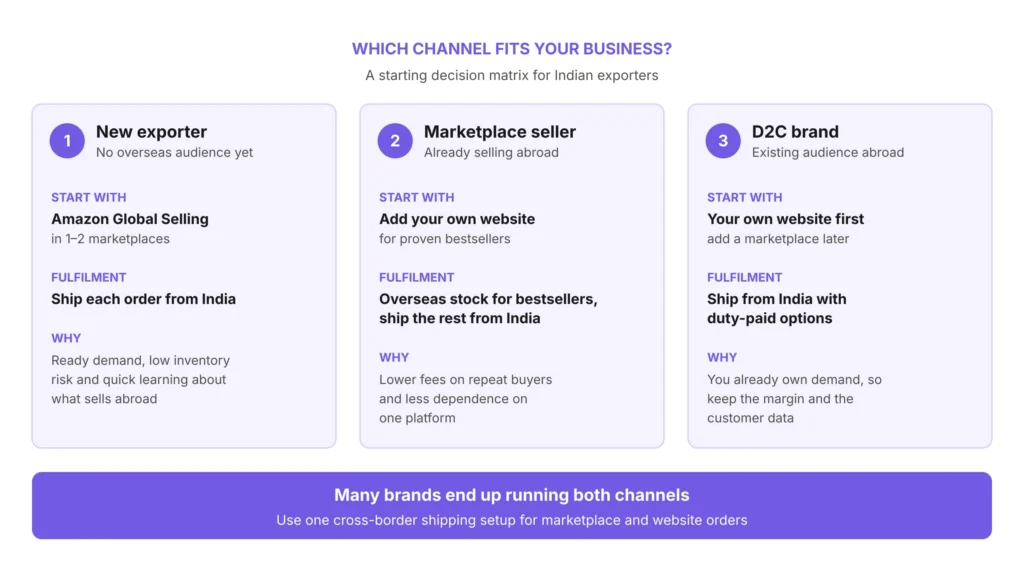
| Your situation | Start with | Fulfilment model | Why |
|---|---|---|---|
| New exporter, no overseas audience | Amazon Global Selling in 1–2 marketplaces | Ship each order from India | Ready demand, low inventory risk, quick learning |
| Established marketplace seller | Add your own website | Overseas stock for bestsellers, ship the rest from India | Lower fees on repeat buyers and less dependence on one platform |
| D2C brand with an existing audience abroad | Your own website first | Ship from India with duty-paid options | You already own demand, so keep the margin and the data |
New exporters
If you’re testing whether overseas buyers want your product, a marketplace lowers the cost of finding out. Pick one or two markets, ship from India and keep your catalogue tight. Our guide to export market selection helps you choose where to start.
Established marketplace sellers
You already know which products sell abroad. The next step is to reduce dependence on one platform. Launch a website for your bestsellers, use package inserts that comply with marketplace rules, and build an email list from website buyers.
D2C brands with existing audiences
If you get organic traffic or social followers from the US, UK, UAE or Australia, your own site can convert them directly. Add a marketplace later if you want extra reach for discovery searches.
The Hybrid Route: Using Both Channels Together
For many Indian brands, the honest answer is “both, in sequence”. A marketplace acts as a demand engine and a testing lab. The website becomes the home for repeat customers and higher-margin bundles.
To make a hybrid model work:
- Keep prices consistent so you don’t undercut either channel.
- Sync inventory so the same stock isn’t sold twice.
- Use one shipping dashboard for marketplace and website orders.
- Track contribution margin per channel, not just revenue.
For a wider view of planning your expansion, read our international eCommerce guide.
Ship Marketplace and Website Orders Abroad With Shiprocket X
Whichever channel you pick, the shipping layer stays largely the same. Shiprocket X is Shiprocket’s cross-border shipping platform, covering 220+ countries and territories. Its channel integrations include Amazon, eBay, Etsy and Shopify, so orders from your marketplace accounts and your Shopify store can sit in one dashboard with single-click order upload.
You can choose economy shipping to the US, UK and Canada in 12–15 business days, or duty-paid DDP shipping to the US in 10–12 days, with customs clearance handled. A branded tracking page and email and WhatsApp updates keep website buyers informed, and the analytics dashboard shows country-wise orders and courier performance. That gives you the numbers to compare channels on real data.
Conclusion
Whether you sell internationally on Amazon vs own website comes down to where your demand comes from and what you can afford to build. Amazon gives you shoppers and structure but takes a fee on every sale. Your website gives you margin, brand control and data, but you must earn every visitor.
Start where the risk is lowest for your stage, measure the real cost per order, and add the second channel once the first one works. With a reliable cross-border shipping setup behind both, you can grow abroad without running two separate businesses.