

When you’re shipping freight, weight isn’t the only factor that affects your costs. The amount of space your shipment occupies also matters, especially when you’re shipping pallets, large products, or bulky materials through a less-than-truckload (LTL) network.
Two shipments can weigh exactly the same but have different shipping costs because of their dimensions. That’s where freight density comes in. Understanding your shipment’s density can help you identify the correct freight class, compare shipping rates, and avoid unexpected charges.
Fortunately, calculating freight density doesn’t have to be complicated. Our freight density calculator makes it easy to determine how much your shipment weighs relative to its size. Here’s how to use it, understand the results, and make smarter LTL shipping decisions.
Freight density calculator
Knowing your freight density is an important step toward understanding your LTL shipping costs. ShipStation’s freight density calculator uses your shipment’s weight and dimensions to calculate its density in pounds per cubic foot (PCF).
What is freight density and why does it matter?
Knowing your freight density is an important step toward understanding your LTL shipping costs. Our freight density calculator uses your shipment’s weight and dimensions to calculate its density in pounds per cubic foot (PCF).
Freight density measures how much a shipment weighs compared to the space it occupies. It’s expressed in pounds per cubic foot (PCF), making it useful for understanding how efficiently freight uses available trailer space.
Consider two shipments weighing 500 pounds. One fits on a compact pallet, while the other occupies twice as much space. Although their weights are identical, the smaller shipment has a higher freight density.
This matters because LTL carriers combine shipments from multiple businesses in the same trailer. Freight that occupies more space can limit the carrier’s ability to accommodate other shipments.
Understanding freight density helps businesses:
- Estimate shipping costs: Accurate density calculations support reliable LTL rate estimates, especially for freight classified by density.
- Identify freight class: Density helps determine the classification of many commodities.
- Improve packaging: Reducing unnecessary space can increase density and potentially lower transportation costs.
- Avoid unexpected charges: Correct measurements reduce discrepancies between quoted and actual shipment information.
Freight density is especially important when shipping large, lightweight products that occupy considerable trailer space relative to their weight.
How to calculate freight density
You don’t need advanced math skills to calculate freight density. Simply determine your shipment’s volume and divide its total weight by that volume.
Step 1: Measure your shipment
Measure the length, width, and height in inches. Include the pallet, protective materials, and any packaging that contributes to the shipment’s overall dimensions.
Step 2: Calculate cubic feet
Multiply the three dimensions to determine cubic inches. Then divide by 1,728 to convert the result into cubic feet.
Cubic feet = (Length × Width × Height) ÷ 1,728
Step 3: Calculate freight density
Divide the shipment’s total weight in pounds by its volume in cubic feet.
Freight density = Total weight (lbs) ÷ Total volume (cubic feet)
Freight density calculation example
Suppose you’re shipping a palletized product with these measurements:
This shipment has a freight density of 11.25 pounds per cubic foot.
For shipments containing multiple pallets, calculate each handling unit’s density separately. National Motor Freight Classification (NMFC) rules generally use individual handling-unit density, although certain exceptions allow calculations based on combined weight and volume.
Want to skip the calculations? Use the freight density calculator above to get your result without doing the math yourself.
How does freight density affect freight class?
Freight class is a standardized classification used in LTL shipping to help carriers establish transportation rates. The NMFC system organizes commodities into 18 classes, ranging from Class 50 to Class 500.
Lower freight classes generally correspond to lower shipping rates, while higher classes can result in higher costs. Actual pricing also depends on the carrier, shipping distance, shipment weight, and other factors.
Freight density plays an important role in determining class for many commodities. A dense shipment occupies relatively little trailer space compared to its weight. A bulky, lightweight shipment takes up more room, potentially limiting the carrier’s ability to transport additional freight.
For freight classified by density, higher density generally corresponds to a lower freight class. However, freight density doesn’t automatically determine freight class. Classification may also consider handling requirements, stowability, liability, and commodity-specific NMFC rules.
The 2025 NMFC updates moved more than 2,000 items to density-based classification and expanded the standard density scale from 11 to 13 categories. These changes make accurate measurements and up-to-date classification information especially important.
Freight density chart: Understanding density and freight class
A freight density chart shows how pounds per cubic foot can correspond to freight classes. It’s a useful reference for understanding how your shipment’s dimensions may affect LTL shipping costs. The following chart shows the standard 13-subprovision density scale adopted through the 2025 NMFC changes.
Source: National Motor Freight Traffic Association (NMFTA), standard 13-subprovision density scale.
The earlier shipment example with a density of 11.25 PCF falls within the Class 92.5 range. However, that class applies only if the commodity is classified using this density scale. Not every type of freight follows these ranges, so always verify the appropriate freight classification before shipping.
How to improve freight density and reduce shipping costs
You can’t always change what your products weigh, but you may be able to reduce the space they occupy during shipping. Better packaging can increase freight density and potentially lower LTL shipping costs. The key is eliminating unnecessary space without compromising product protection.
Reduce empty space in packaging
Oversized cartons and too much empty space inside packaging can increase shipment volume without adding much weight. Choose packaging that fits your products while providing enough protection during transportation.
Improve pallet stacking
Arrange cartons to make better use of available pallet space. Avoid unnecessary gaps, unstable stacking patterns, and excessive overhang. Efficient stacking can reduce overall dimensions while keeping shipments secure.
Review packaging materials
Evaluate whether your current packaging provides the right balance of protection and space efficiency. Smaller cartons or redesigned protective inserts may help reduce shipment volume without increasing damage risk.
Recalculate density after packaging changes
Even small changes to carton dimensions or pallet configurations can affect density. Use the freight density calculator again whenever you change packaging materials, stacking patterns, or shipment configurations.
See how packaging changes freight density
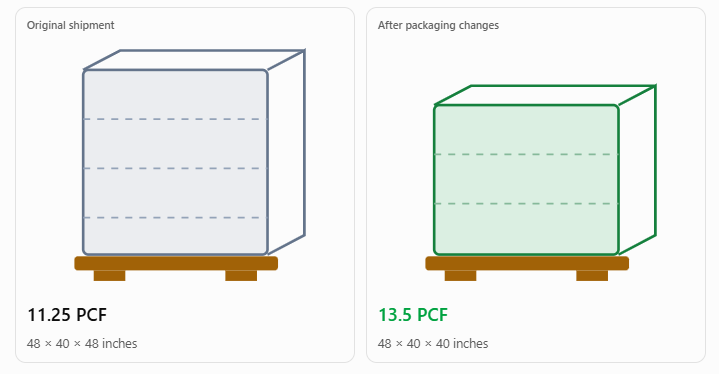
Consider the earlier example of a 600-pound shipment measuring 48 × 40 × 48 inches. Its density is 11.25 PCF. If improved packaging reduces its height to 40 inches while keeping the total weight at 600 pounds, its density increases to 13.5 PCF.
Illustrative comparison assuming the shipment remains 600 pounds, including its pallet and packaging. Under the standard density scale, that difference could move an eligible shipment from Class 92.5 to Class 85. Actual savings depend on the applicable NMFC classification and carrier rates.
Remember that reducing packaging isn’t always the best solution. Adequate protection helps prevent damage, claims, and costly replacement shipments.
Common freight density calculation mistakes to avoid
Small measurement errors can change freight density and lead to inaccurate shipping estimates. Before calculating your shipment’s density, watch for these common mistakes:
- Measuring the product instead of the shipment: Include the pallet, packaging, and materials extending beyond the product.
- Forgetting pallet weight: Use the total weight of the prepared shipment, not just the products.
- Using outdated dimensions: Recheck measurements whenever packaging or pallet configurations change.
- Ignoring irregular shapes: Measure the maximum outside dimensions, including overhang and protruding materials.
- Confusing density with freight class: Use the calculated density alongside the correct NMFC item to determine classification.
The NMFTA also identifies outdated measurements, omitted packaging dimensions, and inaccurate handling of irregular shapes as common density calculation errors. If a carrier’s inspection reveals a different weight or dimensions, it may reweigh or reclassify the shipment. This can result in additional charges or billing disputes. Taking a few extra minutes to measure your freight accurately can help prevent those problems.
Freight density vs. DIM weight: What’s the difference?
Freight density and dimensional (DIM) weight both help carriers account for the relationship between shipment size and weight. However, they’re calculated differently and serve different purposes in shipping. Understanding the difference is particularly useful for businesses that ship both parcels and LTL freight.
Freight density measures a shipment’s actual weight relative to its volume. In LTL shipping, it can help determine the freight class used for pricing.
DIM weight converts a package’s dimensions into a calculated weight using a carrier-specific formula. Parcel carriers generally compare that result with the package’s actual weight and use whichever is greater to determine billable weight.
How is DIM weight calculated?
To calculate DIM weight, multiply a package’s length, width, and height in inches. Then divide that number by the carrier’s DIM divisor.
DIM weight = (Length × Width × Height) ÷ DIM divisor
For example, consider a package measuring 24 × 18 × 12 inches that weighs 20 pounds. Using a DIM divisor of 139:
- Package volume: 24 × 18 × 12 = 5,184 cubic inches
- DIM weight: 5,184 ÷ 139 = 37.3 pounds
- Rounded DIM weight: 38 pounds
Although the package weighs just 20 pounds, the carrier may bill it at 38 pounds because of the space it occupies. Parcel carriers generally use the greater of actual weight or DIM weight, subject to their service rules.
Freight density vs. DIM weight at a glance
The key difference: Freight density helps determine how an LTL shipment is classified, while DIM weight helps determine how much a parcel carrier charges for the space a package occupies.
Frequently asked questions about freight density
Does freight density include pallet weight?
Yes. Include the weight of the pallet, products, and packaging when calculating freight density. Measure the shipment’s full outside dimensions, including any materials extending beyond the pallet, to ensure an accurate calculation.
Can two shipments with the same weight have different freight densities?
Absolutely. A 500-pound shipment occupying 25 cubic feet has a density of 20 PCF. Another 500-pound shipment occupying 50 cubic feet has a density of just 10 PCF.
Does higher freight density mean lower LTL shipping costs?
Not necessarily. Higher density can result in a lower freight class when density-based classification applies. However, LTL rates also depend on shipment weight, distance, carrier pricing, and additional services.
What happens if I calculate freight density incorrectly?
Incorrect measurements can lead to inaccurate rate estimates or freight classifications. If a carrier discovers a discrepancy during inspection, it may reweigh or reclassify the shipment, which may lead to additional charges.
Can I use a freight density calculator for multiple pallets?
You can calculate each pallet’s density using its individual weight and dimensions. NMFC rules generally call for calculating density by handling unit, with certain exceptions when shipping documents report only a combined weight.
Calculate freight density with confidence using ShipStation
Accurate freight density calculations help you prepare reliable shipping information, understand freight classifications, and make better shipping decisions. Whether you’re shipping a single pallet or managing regular LTL shipments, knowing your freight density is a valuable starting point.
Use the freight density calculator above to determine your shipment’s pounds per cubic foot. Then put that information to work with ShipStation.
ShipStation brings parcel and LTL shipping together with competitive rates, access to 50+ LTL carriers, and technology that simplifies everyday shipping tasks. You can compare available carrier options, review rates, and manage shipments more efficiently. Plus, ShipStation Global’s logistics expertise helps you find solutions that fit your shipping needs.
Ready to take control of your shipping costs? Explore ShipStation’s LTL shipping solutions or start your free trial today.

