
Your first overseas orders probably came from the USA. A few Instagram buyers, some Etsy sales, then a steady trickle from your own website. Now someone in London asks if you ship to the UK, a Dubai reseller wants a catalogue, and a friend says Australia is “huge for Indian brands”.
If you’re wondering how to expand export business from one country to several, this is the moment that decides whether growth adds profit or just adds work. Each new market brings new duties, couriers, buyer habits and return patterns. Picking the wrong one can quietly drain the margin you earned in the first.
This guide is for Indian exporters and online sellers who already ship abroad. You’ll learn how to read your own data, score new export markets with a simple framework, compare them using product-level economics and roll out in phases.
What Does It Mean to Expand an Export Business?
Expanding an export business means adding new countries, products or channels to an export operation that already works. For most Indian D2C brands and online sellers, it means taking a proven product range into one or two new countries.
This is different from going global for the first time. You already have an IEC, HS codes, export paperwork and a shipping setup. Your job now is market selection and export market diversification: spreading revenue across countries so one market’s slowdown, tariff change or currency swing doesn’t hurt the whole business.
Diversification became urgent for many Indian sellers after the USA suspended its $800 de minimis exemption in August 2025. Brands that depended on a single market saw landed costs change overnight. A second and third market gives you room to adjust.
Why Your Next Market Shouldn’t Be Picked on Popularity
Most sellers pick their next country by reputation. The UK feels familiar, the UAE has a large Indian community and Australia “loves Indian products”. These are reasonable starting points, but they aren’t a decision.
Country popularity tells you that demand exists somewhere in that market. It doesn’t tell you whether your product, at your price, with your shipping cost, will make money there. A market can have strong demand and still lose you money on every parcel because of weight, duty or returns.
So when you think about how to expand export business into a new country, ask a better question: which country gives my best-selling products the highest contribution margin per order, with the least operational risk? Answering it starts with your own numbers.
Step 1: Mine Your Existing Export Data for Signals
You already hold the best market research you’ll ever get: real buyer behaviour. Before you open a single trade report, pull these numbers for the last 6 to 12 months.
| Data source | What it tells you | Signal to look for |
|---|---|---|
| Orders by country | Where buyers already find and pay for you | Countries with orders you never targeted |
| Customer enquiries | Unmet demand in markets you don’t serve well | Repeated “Do you ship to…?” messages by email, WhatsApp or DMs |
| Website analytics | Where visitors come from and where they drop off | High traffic but low conversion from one country, or carts abandoned at the shipping step |
| Repeat purchases | Whether buyers come back without heavy marketing | Repeat rate by country, not just total orders |
| Product margins by SKU | Which products can absorb international costs | Light, high-value SKUs with healthy gross margin |
| Delivery performance | How well each lane works today | Average transit time, delays and customs holds by country |
| Return and refund rates | Hidden costs by product and market | Size or expectation issues that would repeat in a similar market |
Look for overlaps. A country that shows up in enquiries, website traffic and a handful of organic orders is a much stronger candidate than one that only appears in industry headlines.
Then check your product mix. Your USA bestsellers may not be the right lead products elsewhere. A heavy item that works under one shipping rate can become loss-making on a longer lane.
Step 2: Build a Market-Scoring Framework
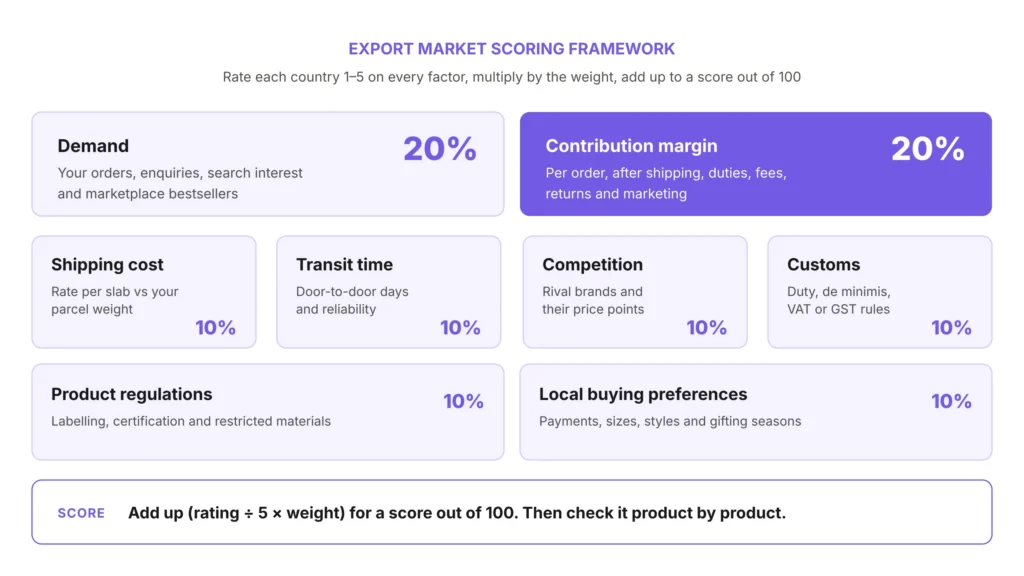
Once you have three to five candidate countries, score them side by side. A weighted scorecard turns gut feel into a decision you can explain to a co-founder or investor.
The Eight Factors to Score
Rate each country from 1 (poor) to 5 (strong) on these factors. The weights below are a sensible default for a B2C exporter; adjust them to suit your business.
| Factor | Weight | What to check |
|---|---|---|
| Demand | 20% | Your own orders and enquiries, marketplace bestsellers, search interest for your category |
| Expected contribution margin | 20% | Margin per order after shipping, duties, taxes, fees, returns and marketing |
| Shipping cost | 10% | Rate per 500 g slab and how your parcel weight and volume fit it |
| Transit time | 10% | Typical door-to-door days and how reliable they are |
| Competition | 10% | Local and international brands in your niche and their price points |
| Customs complexity | 10% | Duty rates for your HS codes, de minimis limits, VAT or GST collection rules |
| Product regulations | 10% | Labelling, certification, restricted materials and ingredient rules |
| Local buying preferences | 10% | Payment methods, sizes, styles, gifting seasons and delivery expectations |
Multiply each score by its weight, then add them up. A perfect market scores 100.
Where to Find the Inputs
Your shipping platform gives you rates and transit data by lane. Trade data tools help with demand and competition. The US government’s Market Diversification Tool is a good model of the approach: it ranks markets using product-level trade data and country-level indicators like logistics performance and tariffs.
For tax and duty rules, always go to the destination’s official guidance. For example, the UK charges VAT at the point of sale on consignments worth £135 or less, and overseas sellers who sell directly to UK buyers must register for UK VAT, according to GOV.UK. Our guide to de minimis values by country is a useful starting point for other markets.
Contribution Margin Is the Deciding Factor
Contribution margin is what’s left from each order after all variable costs. For an export order, that means product and packaging cost, international shipping, destination duties and taxes you absorb, payment or marketplace fees, expected returns and the marketing spend per order.
Work it out per product, per country. Our explainer on landed cost shows how to build the cost side, and this export pricing strategy guide helps you set a price that covers it.
Example: A USA Seller Choosing Between the UK, UAE and Australia
Here’s an illustrative example. The brand and figures are hypothetical, but the method is exactly what you’d apply to your own data.
A Jaipur-based home textiles brand sells hand block-printed cushion covers and bedsheets. About 80% of its export orders go to the USA through its Shopify store. Its data shows enquiries from the UK and UAE, plus some traffic from Australia.
How the Three Markets Score
Using the framework above, the team scores each country.
| Factor (weight) | UK | UAE | Australia |
|---|---|---|---|
| Demand (20%) | 4 | 3 | 3 |
| Contribution margin (20%) | 4 | 3 | 2 |
| Shipping cost (10%) | 3 | 4 | 2 |
| Transit time (10%) | 3 | 5 | 2 |
| Competition (10%) | 3 | 2 | 4 |
| Customs complexity (10%) | 3 | 4 | 3 |
| Product regulations (10%) | 4 | 4 | 3 |
| Local buying preferences (10%) | 4 | 3 | 4 |
| Weighted score (out of 100) | 72 | 68 | 56 |
Australia looked like the obvious choice on popularity: a large English-speaking market with lighter competition in this niche. But the longer lane means higher shipping cost and slower delivery, which drags down both the margin and the experience scores.
Product-Level Economics Change the Picture
The scorecard is a shortlist, not the final answer. The team then models contribution margin per order for each product in each market.
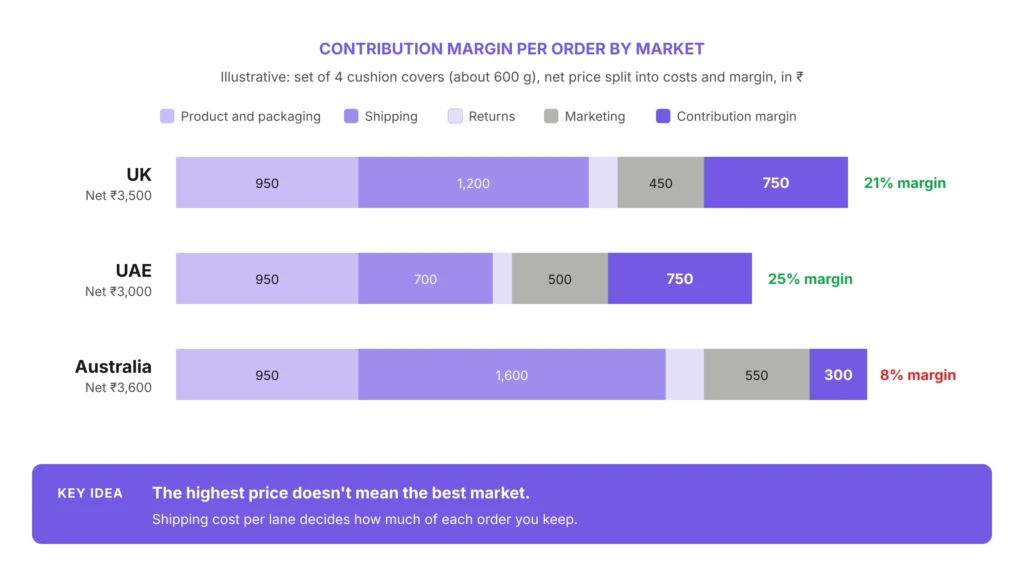
For a set of four cushion covers weighing about 600 g, the illustrative numbers look like this:
| Per order (illustrative, ₹) | UK | UAE | Australia |
|---|---|---|---|
| Net price after taxes and fees | 3,500 | 3,000 | 3,600 |
| Product and packaging | 950 | 950 | 950 |
| International shipping | 1,200 | 700 | 1,600 |
| Expected returns and refunds | 150 | 100 | 200 |
| Marketing cost per order | 450 | 500 | 550 |
| Contribution margin | 750 | 750 | 300 |
The UK and UAE earn the same margin per order on cushion covers, even though UK buyers pay more. Lower shipping cost and fewer returns close the gap for the UAE.
The heavier bedsheets tell a sharper story. At over 2 kg, shipping eats most of the margin to the UK and Australia, but the shorter, cheaper lane to the UAE keeps bedsheets profitable there.
The Decision
The brand picks the UK as its next market for cushion covers and table linen, its lightest, highest-margin range. It runs a smaller UAE test focused on bedsheets, where the shipping economics favour heavy products. Australia goes back on the watch list until order volumes justify stocking inventory there.
Notice that this isn’t a single “best country”. It’s the best product-market fit, chosen on unit economics. That’s the core of a sound global market expansion strategy.
Step 3: Roll Out in Phases, With Targets Set in Advance
Even a well-scored market is still a hypothesis. A phased rollout protects your cash and your team’s time, and it tells you early if your assumptions were wrong.
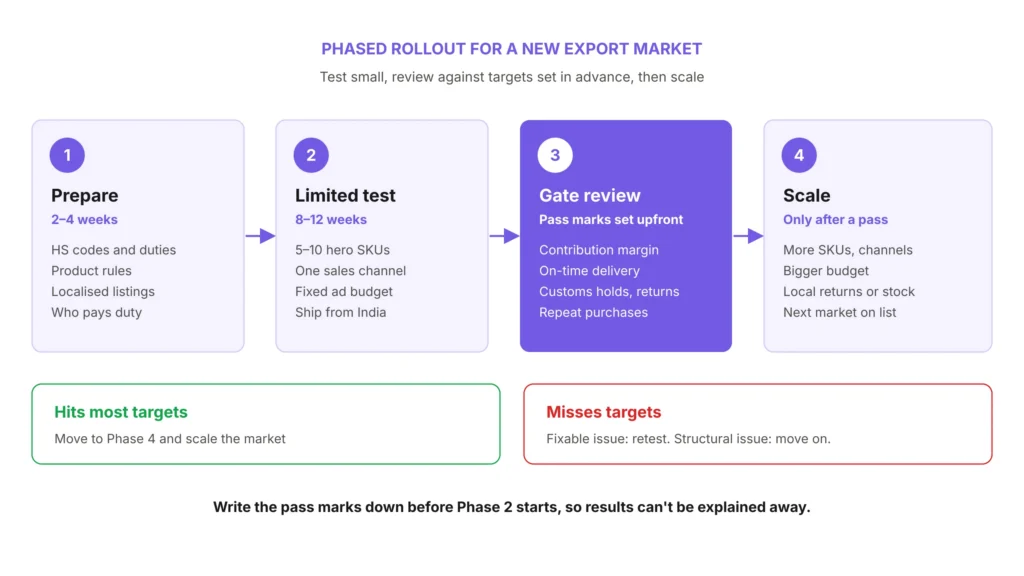
Phase 1: Prepare the Market (2 to 4 Weeks)
Get the basics ready before the first ad goes live:
- Check HS codes, duty rates and any labelling or certification rules for your test SKUs. Our HS code guide explains how codes drive duty.
- Localise listings: currency, sizes, spellings, units and delivery promises.
- Decide who pays duties and taxes, and show it clearly at checkout.
- Read the country guide for your market, such as exporting to the UK, UAE or Australia.
Phase 2: Run a Limited Market Test (8 to 12 Weeks)
Keep the test small and controlled. Launch 5 to 10 hero SKUs, one sales channel and a fixed marketing budget. A marketplace such as Amazon Global Selling can work as a low-risk test channel if you don’t want to build traffic to your own store yet.
Ship everything from India during the test. Don’t stock inventory overseas until the market proves itself.
Phase 3: Review Against Predefined Targets
Write your pass marks down before the test starts, so results can’t be explained away later. Set both commercial and operational targets. The thresholds below are examples; base yours on your current market’s performance.
| Metric | Example target | Why it matters |
|---|---|---|
| Contribution margin per order | At least 20% of net price | Proves the market makes money, not just sales |
| Conversion rate | Within 70% of your USA rate | Shows pricing, trust and localisation are working |
| On-time delivery | 90% or more within the promised window | Drives reviews and repeat orders |
| Customs hold rate | Under 2% of shipments | Flags HS code, invoice or documentation problems |
| Return and refund rate | Under 8% of orders | Highlights size, quality or expectation gaps |
| Repeat purchase rate | Trending up month on month | Shows you’re building real customers |
If the market hits most targets, move to the next phase. If it misses, find out why. A fixable problem like wrong sizing deserves a second test; a structural one like shipping cost wiping out the margin means you move on.
Phase 4: Scale What Works
Add more SKUs, a second channel and a bigger marketing budget. Once demand is steady, consider local returns handling or stocking bestsellers in the country to cut delivery times.
Then go back to your scorecard and test the next market. Each launch gets faster because you reuse what worked. Our guide on how to scale your eCommerce business globally covers the growth stage in more depth.
Common Mistakes When Expanding Into New Export Markets
Most failed expansions share a few avoidable errors:
- Launching several markets at once. You can’t tell what’s working, and your team spreads too thin.
- Copying USA pricing. Each market has different duties, taxes and shipping costs, so each needs its own price.
- Leading with the wrong products. Your top seller at home may be too heavy or too regulated for the new lane.
- No exit criteria. Without pass marks, a weak market can run for a year on hope.
- Ignoring returns. Cross-border returns are expensive. Plan them before launch with this guide to returns management in cross-border shipping.
Test and Scale New Markets With Shiprocket X
Expanding into new countries is easier when every market runs from the same shipping setup. Shiprocket X is Shiprocket’s cross-border shipping platform for Indian sellers. It lets you ship to 220+ countries and territories from one dashboard, so testing the UK or UAE doesn’t mean signing up with a new courier. Your past shipments on the platform also give you real cost and delivery data for the shipping rows of your scorecard.
During a market test, its analytics dashboard shows courier performance and country-wise order distribution, which feeds straight into your Phase 3 review. Branded tracking pages and email and WhatsApp updates keep new overseas buyers informed while you build trust in a fresh market. For the USA, duty-paid shipping estimates duties at booking, so buyers pay nothing at the door.
Conclusion
Learning how to expand export business profitably comes down to three moves. First, mine your own orders, enquiries, repeat purchases, margins, delivery data and returns for real signals. Second, score candidate countries on demand, cost, speed, compliance, buying habits and contribution margin. Third, test small and scale only when the numbers say yes.
Choose your next market by product-level economics, not by popularity. The right market is the one where your best products make money and your operations hold up, even if it isn’t the biggest name on the list.