



If you got that first radio job pre-2000, the new music component was always a massive part of the industry’s platform. It’s not that new music exposure isn’t a major aspect of how radio’s music stations operate, it’s just that it has splintered in so many directions, it is hard to keep up with all the discovery points.
Today’s “blast from the past” blogpost on a #ThrowbackThursday is a reminder of how much has changed in radio over just the past five years when this was first published. The post is an interesting look back – oddly enough – at the growing role and importance of catalog content, not just to radio but to the record industry as well.
Meantime, getting discovered when you’re a fledgling artist has never been more tenuous, even with platforms like Spotify and Apple Music filling the playlists for millions of listeners. Yet, for the local independent band or solo performer, it’s never been a more lonely, difficult journey.
I thought about the crude methodology of sidewalk busking – street players with that open guitar case hoping for enough tips to sustain themselves – when Mike Stern told me the truly sad news that the Irish musician, Glen Hansard (pictured) lost his life yesterday in a motorcycle accident on the same Dublin streets where he was ultimately discovered.

Hansard was the force behind the film, “Once,” which became an indie hit in 2007, an emotionally powerful love story with a powerful soundtrack that has stayed with me all these years. Hansard won an Oscar for Best Original Song for “Falling Slowly,” a beautiful duet he co-wrote and performed with Markéta Irglová.
I’ve been fortunate enough to visit Dublin twice now, and every time I see a musician playing for tips on those streets, I’ve thought about Hansard and the impact the film and his presence had on me emotionally and musically.
The next time you see a street performer – a busker – entertaining passers-by, take a moment, thank them, and if you can, leave them a tip.
Condolences to Hansard, his family, friends, and fans. And may his memory be a blessing. – FJ
“What’s The State Of New Music Discovery?”
July 2021
Radio and records veterans are only too aware of the basic trajectory of new music discovery. For eons, the labels have first identified artists who recorded albums and singles. The very best songs were then released and delivered to radio stations in the appropriate format. And then their promotional machines took over. Concerts, station visits, and other marketing activity ensued.
And that is primarily how hits were made. Some songs – especially by established artists – were added on their day of release. Others required both the ears and courage of a program or music director, willing to go out on a limb to support a new song or an up-and-coming band.
First, it was surveying record stores and tracking requests to determine if a new song had a chance to crack through. Later, it was callout research that helped determine whether radio was on the right track – figuratively and literally.
But in recent years, the old model has developed stress cracks. Labels have less faith in radio. And most stations are no longer as adventuresome as they once were, especially at a time when the larger markets are reliant on meters to determine how many are listening.
And so, the labels have become more reliant on other methods of discovery – streaming services like Spotify, Apple Music, and Pandora, the channels that play new music on SiriusXM, songs featured in TikTok videos, and Shazam hits on new music consumers have the urge to identify.
You’d think that with all these new music exposure elements, the music industry would have infinitely more reliable ways of making one of their projects successful. But there is much evidence to the contrary, suggesting the further they move away from radio, their marketing methods become less reliable.
Case in point: A story in Heavy Consequence by Jon Hadusek uses the “pure album sales” metric – physical + digital sales – to make the point that rock is indeed not dead yet. Aside from K-Pop phenoms BTS (at the top of the chart), the rest of the big-sellers are Rock acts:
-
-
-
-
-
- BTS
- Beatles
- Metallica
- Queen
- Fleetwood Mac
- Pink Floyd
- AC/DC
- Nirvana
- Foo Fighters
- Led Zeppelin
-
-
-
-
As I stared at this august list of bands that can sell albums, most are in the Classic Rock department. And Hadusek reaches the same conclusion:
“(After BTS), the rest of the list is dominated by classic rock and metal bands that remain as visible and vital as ever.”
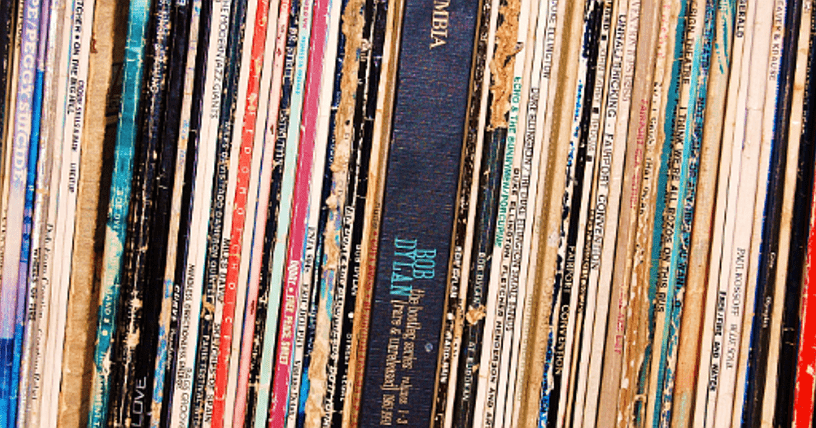
While this makes a statement about the timeless quality and resonance of music that is 30, 40, and even 50 years of age, it also says something about the ability of newer acts to break out and become the new stars of 2021.
More proof of a different kind comes from Music Business Worldwide and a story by Tim Ingham with this blaring headline:
“Over 66% of all music listening in the U.S. is now of catalog records, rather than new releases”
The previous story gives the hierarchy of albums, mostly by groups that have been around for decades. And now we learn that digital streaming – the modern way to listen to music – is dominated by catalog – i.e., older music.
Ingham reports new MRC Data shows that in the first half of this year, two-thirds (66.4%) of total consumption was, in fact, catalog (defined as having been released over 18 months after a listener presses “play”).
The trendline on this data shows a pattern. In the first six months of 2020, 63.9% of consumed music was catalog. The year before – in the pre-COVD 2019 – it was 60.8%.
 Conversely, of course, consumption of new music is headed in the opposite direction.
And with a little voodoo math, Ingham extrapolates this trend out to 2030. If it holds, catalog music will reach 76% of listenership, compared to new music at a very puny 24% for that year in the not-so-distant future.
To veterans of radio and records, this trend seems downright counter-intuitive – except that it’s happening right before our very ears.
As the record companies devote less energy and resources on radio exposure of new music, the less current bands and their songs seem to be having impact – not just on our sales, but in our culture.
So, what is radio’s role in new music discovery in 2021 – and what should it be?
To determine how core radio listeners see it, let’s look at this year’s Techsurvey (conducted in January/February), and why core listeners still enjoy broadcast radio. We give our respondents a long list of potential attributes, and it includes “discover new music/new artists.”
This year, nearly one in four (25%) told us new music discovery is a main driver for broadcast radio listening. But the startling finding is the eight year trend:
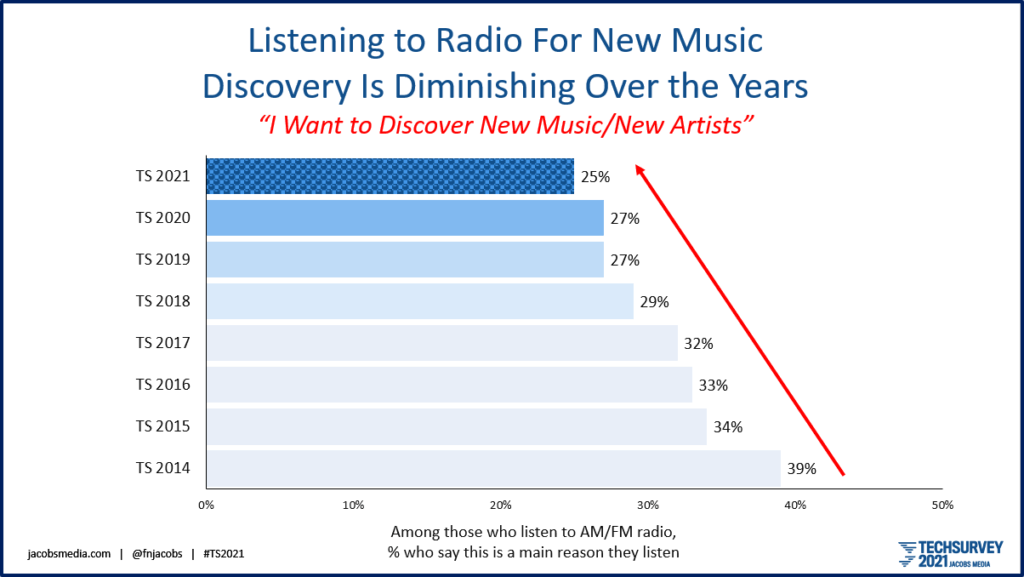
The chart is dramatic, reinforcing the larger trend that new music appears to be having less and less impact on our culture, and it is certainly a less impactful reason for listening to radio.
But why is that?
As consumers’ listening time is fragmented across a seemingly infinite number of audio sources, there is less collective airplay of new songs and emerging artists. Radio programmers know that frequency of a song’s exposure is a key ingredient to reach mass numbers of consumers. And the more outlets that play a song, the greater the likelihood it will become a hit.
As the Classic Rock guy, it pains me to see an opportunity for broadcast radio go untapped. But that is, in fact, the case with new music exposure on U.S. radio airwaves.
At the time Classic Rock exploded on the air and in the ratings back in the early-mid ’80s, music exposure on FM radio and MTV had been dominated by new stuff: “Hot Hits,” music videos, Michael Jackson and “Flashdance.” And that is a big part of what opened the door to a format that was 100% catalog.
And so you have to wonder if a mirror image exists with radio in America in 2021. Yes, there are stations playing new music from many different format genres, but the industry’s aversion to teen consumers is so rigid, it’s hard to imagine anything especially new or innovative breaking out in a major market geared to young people.
What if there was a station that only played new music – across genres – that was all about music discovery?
Could it move the needle on selling new music rather than catalog?
Could it recharge the types of music consumers stream and listen to over the air?
Could it get ratings? And could salespeople actually sell them?
Could it influence foreign broadcasters to actually tune in American radio to see what’s going on – like they did in decades past?
Could it actually stimulate young people to listen to the radio – perhaps discovering it – in some cases – for the very first time?
Well, could it?

President & Founder at Jacobs Media
Jacobs Media has consistently walked the walk in the digital space, providing insights and guidance through its well-read national Techsurveys.
In 2008, jacapps was launched – a mobile apps company that has designed and built more than 1,300 apps for both the Apple and Android platforms. In 2013, the DASH Conference was created – a mashup of radio and automotive, designed to foster better understanding of the “connected car” and its impact.
Along with providing the creative and intellectual direction for the company, Fred consults many of Jacobs Media’s commercial and public radio clients, in addition to media brands looking to thrive in the rapidly changing tech environment.
Fred was inducted into the Radio Hall of Fame in 2018.
