

Tamy Michel grew up watching her father run a football club through prison, political upheaval and the endless uncertainties of life in Haiti.
Solange Michel spent 18 years leading Baltimore SC, one of the country’s most storied clubs. In the 1990s, he was jailed amid the turmoil that engulfed Haitian politics but the club survived. Later, Tamy Michel’s aunt, Simone Desvarieux, took over. The family have been stewards of Haitian football since 1974.
Today, Michel represents players at the highest levels of the global game, from Ricardo Adé, the defensive leader of the Ecuadorian powerhouse LDU Quito, to Jean-Ricner Bellegarde, coming off a Premier League season with Wolverhampton Wanderers, and Haiti’s record goalscorer, Duckens Nazon.
For much of the world, Haiti’s return to football’s biggest stage after a 52-year absence, beginning at 2am on Sunday against Scotland at Boston Stadium, has been framed as an underdog story: a feelgood tale from a country more often associated with political turmoil, gang violence, natural disasters and humanitarian crises than elite sport. Michel sees something else entirely.
“People usually say we’re not ready,” she says. “A lot of people never expected Haiti to make it. When the odds were against them, they never stopped. People forget that football is played on the field. They look at statistics and rankings and assume Haiti can’t compete. But at the end of the day, it’s 11 against 11.” The surprise, she suggests, says as much about outsiders’ assumptions as it does about Haiti itself.
The team that have arrived at the 2026 World Cup, remarkably having booked their place despite playing every qualifier away from home, bear little resemblance to the one many casual observers might imagine. Only 10 of Haiti’s 26 players were born in the country. The squad includes Bellegarde, who plays for Wolves; Isidor, fresh from helping Sunderland to seventh in England’s top flight; Nazon, whose career has spanned France, England, Turkey and Iran; and Adé, who has established himself as one of South America’s most respected defenders.
Yet Michel rejects the suggestion that Haiti have become some kind of diaspora side. “I see a national team,” she says. That distinction matters because, for all the different paths that brought them together, many of Haiti’s players faced a similar decision. They could have built successful careers without pulling on a Haiti shirt.
Bellegarde’s story illustrates the point. Born and raised in France, he came through one of the world’s most productive football systems and won caps for France’s youth national teams before establishing himself in the Premier League. Yet when the opportunity arose to represent Haiti, the decision ultimately became less about football than identity.
“Although I was born in France, Haiti is always in my blood,” Bellegarde said. “So when Duckens Nazon called me and said it was time, that Haiti needed me, that this was our moment, things shifted for me. You don’t turn that call down.”
The conversation crystallized something he had long felt. Haiti, he says, remained home in a deeper sense: a connection to his parents, his family and the country that shaped their lives.
The same sentiment echoes throughout the squad. Haiti may not have been where many of these players learned the game, but it remained the place they chose to represent.
Haiti’s history contains a narrative entirely different from the prevailing international coverage. It became the world’s first independent nation founded by formerly enslaved people after a successful revolt, a legacy that shapes how many Haitians understand themselves and their place in the world.
That tension resurfaced this year when Fifa required the national team to alter a World Cup jersey that featured imagery from the Haitian revolution. Months earlier, Olympic officials had raised similar objections to the inclusion of the revolutionary leader Toussaint Louverture on Haiti’s Winter Games uniforms. The disputes served as a reminder that Haiti’s story is larger and more complicated than the stereotypes often attached to it.
Adé understands that burden better than most. Unlike many of his teammates, the 36-year-old defender grew up in Haiti before building a career across the Americas. As one of the team’s leaders, he has watched expectations settle on the squad’s shoulders. Asked what responsibility comes with representing Haiti on the world stage, he does not talk about tactics or results. Instead he talks about the people watching back home. “Whenever we win a game, people are always happy,” Adé tells the Guardian. “They will be in the street and everything.”
The World Cup offers a chance to present another image of Haiti. “People see too much bad news,” Adé says. “I’m not blaming them, but that’s what they see. Once you step foot in the country, you’re going to see other things.”
after newsletter promotion
Millions of viewers who know little about Haiti will encounter the country through this team in the coming weeks. For many of them, these matches may be their most sustained exposure to Haiti in years. “Now soccer is the face of Haiti,” Adé says. “It’s the good thing about Haiti. Now people are talking about Haiti because of soccer and because of the World Cup.”
The responsibility extends beyond winning matches. “The thing we are doing is showing Haiti in a different way,” Adé says. “Showing that we can have less, but we can do much.”
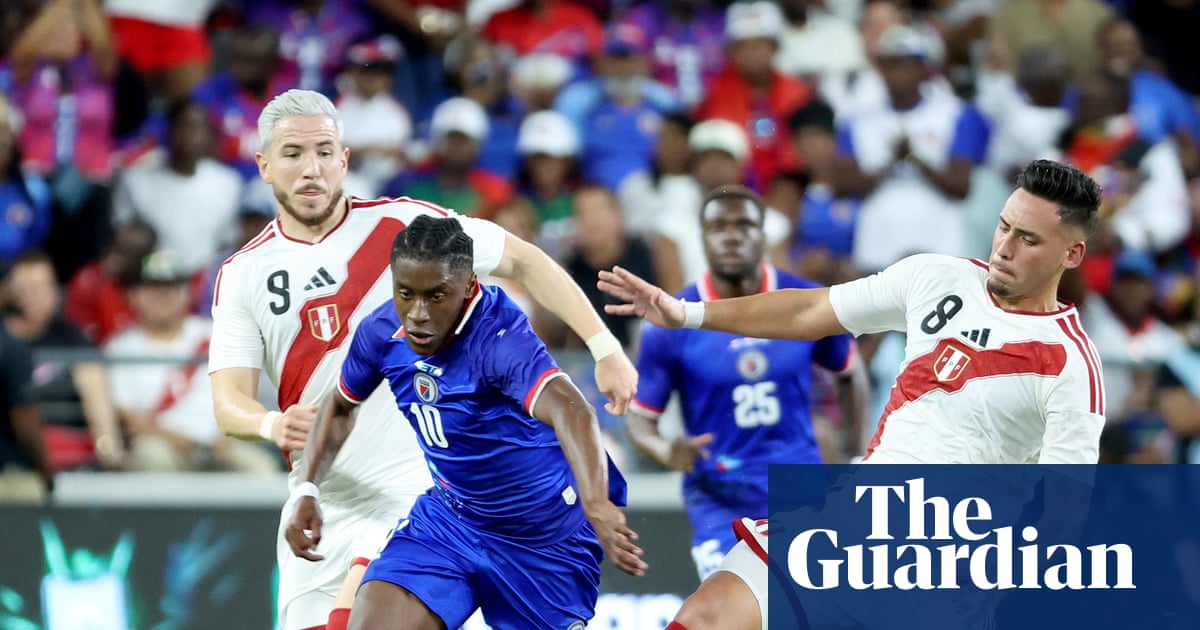
Haiti have not played a home match since 2021, yet support has followed the national team wherever they have gone. Michel recalled last week’s friendly against Peru in Miami that drew about 27,000 spectators. By her estimate, more than 20,000 were Haitian. With travel from Haiti prohibitively expensive for many and US visa restrictions limiting access for others, the diaspora has become the public face of Haitian support during the tournament. Scottish officials expect a similar dynamic in Foxborough, where the famed Tartan Army may find itself outnumbered by supporters whose connection to Haiti spans generations and continents.
Next week Les Grenadiers face the five-time champions Brazil in Philadelphia on Juneteenth [19 June]. Fans are expected to descend on the city from New York, Boston, Montreal, south Florida and beyond, turning the match into something larger than sport: a gathering of a nation spread across the world.
“There was a time when teams looked at Haiti as an easy opponent,” Michel says. “But you could see how hungry the players became. They always wanted to elevate Haiti and were proud to represent the country.
“The biggest change is that it’s become more than football. It’s family. The structure has improved too: travel, organization, conditions for players. The sport has evolved a lot. And now we’re in the World Cup. That’s proof of how much has changed.”
Some fans will remember Haiti’s only previous World Cup appearance in 1974, when Emmanuel Sanon ended Dino Zoff’s record streak of minutes without conceding a goal and briefly brought Italy, one of football’s giants, to their knees. Others may know the country’s place in World Cup history through Joe Gaetjens, the Haiti-born dishwasher whose goal delivered the USA’s famous upset of England in 1950. Many, however, have never seen Haiti play on the sport’s biggest stage. Some have never even set foot in the country they will spend the afternoon cheering for.
Yet for a few hours, geography will matter less than identity. Families that left Haiti decades ago, children raised thousands of miles from the island and recent arrivals who still call it home will find themselves united beneath the same flag, singing the same anthem and investing the same hopes in the same team. For decades, Haiti has often been introduced to the world by others. This month, its footballers will do the introducing themselves.
“I want them to know a little bit about our story,” Adé says. “We’ve been fighters for a long time.”
