

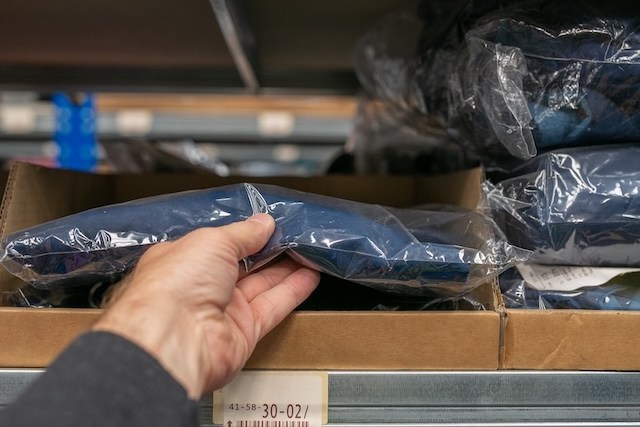
Every apparel product you design multiplies fast. One t-shirt can become 30 different SKUs once you account for sizes and colors. Each variant needs its own barcode, its own stock count, and its own replenishment timeline.
When you sell across direct-to-consumer (DTC), Amazon, retail, and wholesale channels, those counts need to update everywhere within seconds. Strong apparel inventory management means tracking every variant at the SKU level, syncing stock across every sales channel, and using data to stay ahead of demand.
Get it right, and you avoid both stockouts that cost you revenue and excess inventory that ties up capital.
This guide breaks down why managing inventory for apparel brands is uniquely complex, five best practices to keep stock accurate, signs you’ve outgrown manual processes, and how ShipBob helps apparel brands manage inventory at scale.
Why apparel inventory management is uniquely complex
- Variant-level complexity: Variant-level complexity is what sets apparel apart from simpler product categories. A brand selling one hoodie in five sizes and six colors isn’t managing one product; each has its own demand curve, reorder point, and sell-through rate.
- Seasonal demand: The fashion calendar makes forecasting even harder. Spring/summer and fall/winter collections, BFCM, holiday gifting, and trend-driven demand shifts create peaks and valleys that last year’s data can’t always predict. The financial stakes cut both ways: a stockout during a peak selling window means lost revenue you can’t recapture, while overbuying leads to markdowns, dead stock, and cash flow strain.
- Multichannel inventory management: When those SKUs sell across multiple channels simultaneously, stock levels have to update across all platforms within seconds. Even a brief delay can result in overselling and canceled orders, which erodes customer trust.
- Bagging and barcoding: all apparel must arrive at fulfillment centers individually bagged and barcoded, which adds time and cost you need to factor into inbound logistics planning from the start.
5 best practices for apparel inventory management
These best practices cover the operational foundations that help apparel brands keep stock accurate, avoid costly mistakes, and scale without losing control of their inventory.
1. Use demand forecasting to plan ahead of seasonal swings
Start with historical sales data broken down by SKU, channel, and time period. Build baseline demand forecasts for upcoming seasons by looking at sell-through rates for individual size and color variants, not just product-level totals. A medium blue hoodie and an XXL red hoodie, for example, have very different demand curves.
From that baseline, layer in seasonality variables like the fashion calendar, BFCM, and holiday spikes. Then adjust forecasts as real-time signals come in; for instance, if a specific colorway starts trending on social media or a retailer places an unexpectedly large order, your forecast should flex to reflect that.
ShipBob’s AI Decision Engine automates much of this work by analyzing historical sales trends, current demand data, and seasonality variables to inform replenishment decisions.
Automated replenishment recommendations refresh weekly, so you’re working with current data rather than static spreadsheets.
2. Set reorder points, safety stock levels, and low-stock alerts
A reorder point is the inventory threshold at which you should trigger a new purchase order. Calculate it by factoring in your supplier lead time and average daily sales velocity for each SKU.
For apparel brands working with overseas manufacturers, lead times can stretch to 60 to 90 days, so your reorder points need to account for that lag.
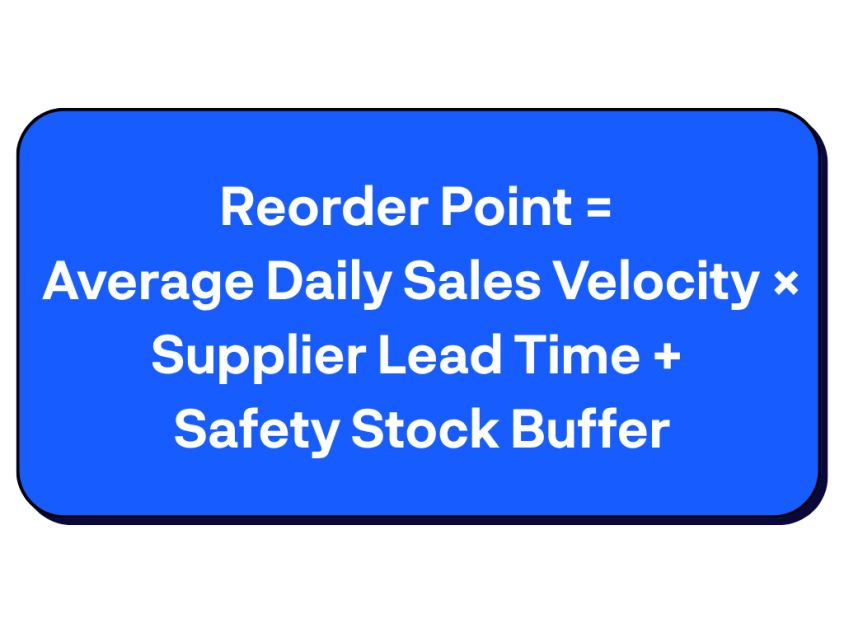
Safety stock adds a buffer on top of that threshold to absorb demand spikes and supply delays. Set it based on your demand variability and lead time variability ( and remember that SKUs with unpredictable demand or inconsistent lead times need a larger buffer).
Once both numbers are in place, automate low-stock alerts and reorder notifications at the SKU level so you’re not manually checking spreadsheets.
ShipBob’s platform provides days of inventory remaining, sell-through velocity, and reorder notifications to help you stay ahead of stockouts without over-ordering.
3. Implement barcoding to improve fashion inventory accuracy
Barcoding every unit and scanning at receiving, picking, and packing reduces human error when fulfillment teams handle visually similar items. Barcodes let the system verify each pick automatically, even when items like a medium black v-neck and a large black v-neck look nearly identical in a bin.
The accuracy gains are measurable. Pit Viper eliminated approximately 2,100 mis-picks per year and reached 99.7% order accuracy after implementing barcode scanning throughout their fulfillment process with ShipBob.
“One of the biggest reasons we went with ShipBob is the multiple checks from start to finish. The WMS makes it really hard to send out the wrong product. It still happens on rare occasions – but it happens a lot less than before. Before we implemented ShipBob’s WMS, our order accuracy rate was around 92%. Now we’re at 99.7% for order accuracy, which equates to 2,100 less mispicks a year on average.”
Jourdan Davis, Operations Manager at Pit Viper
Bunker Branding, which manages over 200,000 active SKUs, relies on the same barcoding infrastructure to maintain accuracy across one of the largest variant catalogs in ShipBob’s network.
“ShipBob’s WMS makes it almost impossible to do things wrong. Eliminating the potential for human error during picking and packing has been great. That was our biggest problem before. Last time I checked, our error rate was less than 1%. We’re shipping out over 10,000 orders per month.”
Clint Sanders, Vice President of Operations at Bunker Branding
4. Build a single source of truth across every sales channel
When a unit sells on any channel, the available count should update everywhere else within seconds. For apparel brands managing thousands of SKUs across DTC, marketplace, retail, and business-to-business (B2B), this is how you prevent overselling.
Making that work requires tight integration between systems. The WMS or fulfillment partner typically owns the physical inventory data, while the storefront or order management system handles what’s available to promise to customers. These systems need to communicate continuously.
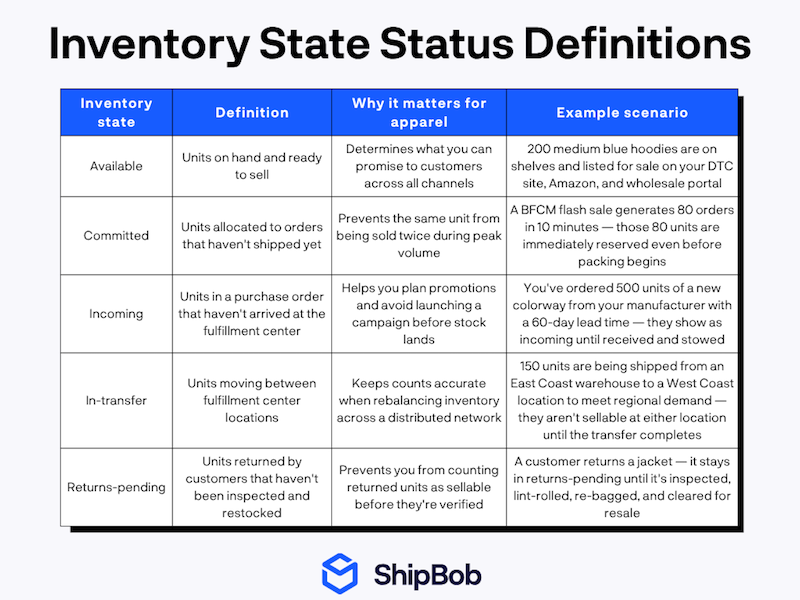
That communication also needs to account for more than just “in stock” and “out of stock.” Apparel brands need to track several inventory states: available, committed, incoming, in-transfer, and returns-pending. Returns-pending matters especially for apparel given higher return rates, since a returned unit isn’t available to sell again until someone inspects and restocks it.
ShipBob’s omnichannel advantage keeps DTC, marketplace, retail, and B2B orders tied to a single inventory pool.
When a sale happens on one channel, the available count updates everywhere else within seconds.
True Classic, for example, gained unified visibility across four countries and multiple retail partners through this approach.
5. Evaluate centralized vs. distributed fulfillment
Centralized fulfillment means shipping from one location. It’s simpler to manage and works well for brands with a concentrated customer base.
Distributed fulfillment uses multiple locations to reduce your average shipping zone, which translates to lower shipping costs and faster deliveries.
The tradeoff is operational complexity. Distributed inventory requires strong location-level visibility so your team knows exactly how much stock sits in each warehouse and can rebalance when one location runs low. Without that visibility, you risk stockouts at high-demand locations while inventory sits idle elsewhere.
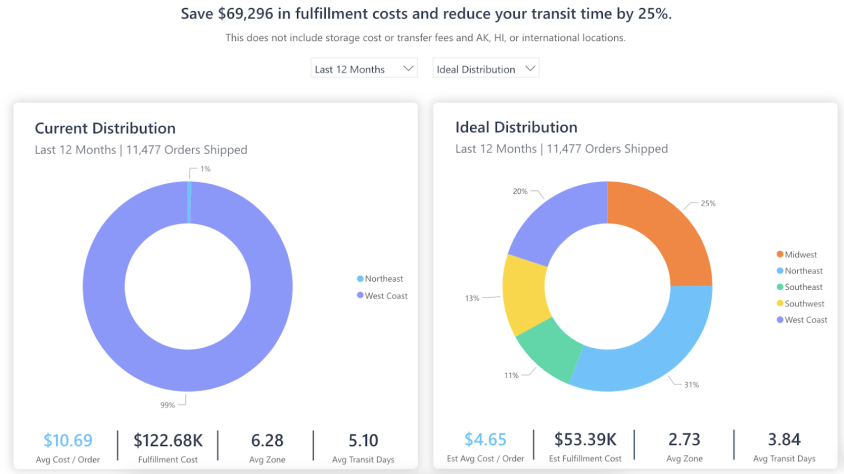
ShipBob’s Inventory Placement Program (IPP) reduces that complexity by automating distribution across US fulfillment centers. You send inventory to one hub, and ShipBob’s algorithms distribute it based on demand forecasting and geographic order data.
Note: IPP is available in the US only, and brands should evaluate whether their SKU mix and order volume support a multi-location strategy before committing.
Signs you’ve outgrown manual processes
If any of these sound familiar, it may be time to move beyond spreadsheets and manual workflows:
- Your SKU count has exceeded what a spreadsheet can track accurately.
- Stock discrepancies are increasing, and you can’t pinpoint where the errors start.
- You’re reconciling inventory manually across channels after every sale.
- Receiving and restocking takes longer than it should because there’s no standardized process.
- You’re spending more time managing operations than growing the brand.
These signs are especially common for apparel brands crossing from a few hundred orders per month to thousands, or expanding from one sales channel to three or more. The variant complexity unique to apparel accelerates the point where manual processes break down.
For brands that want to keep fulfillment in-house but need more control, ShipBob WMS provides warehouse management, inventory management, and order management in one platform. It includes prescriptive visual packing flows that reduce mis-picks and flexible picking options.
For brands ready to outsource, ShipBob’s outsourced fulfillment removes the operational burden while providing the same technology and visibility. You get inventory tracking, automated order routing, and access to ShipBob’s network of fulfillment centers without managing warehouse staff or space.

How ShipBob helps apparel brands manage inventory at scale
At ShipBob, we give apparel brands the technology, fulfillment network, and operational expertise to manage high-SKU catalogs, keep inventory accurate across channels, and scale without adding headcount.
Real-time visibility and omnichannel inventory syncing
Our platform provides a single dashboard view of inventory across all fulfillment locations and sales channels. You can see available, committed, incoming, and in-transfer units for every SKU, down to individual size and color variants.
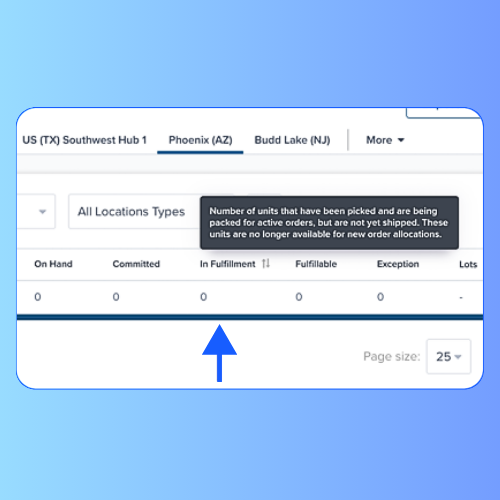
Our single inventory pool keeps DTC, marketplace, retail, and B2B stock updates flowing automatically. When a unit sells on one channel, it’s reflected everywhere else within seconds. This prevents the overselling problems that plague apparel brands with large catalogs.
“Before, when we made sales in-person at a stadium, we had no way of seeing how those sales impacted stock counts. Now, with the Shopify POS connection ShipBob built for us, the data from in-person sales syncs with Shopify and ShipBob WMS, so we can see inventory levels change in real time.
We finally have cohesive visibility across our online Shopify store, our retail stalls, and our warehouse, and ShipBob has done a really good job of making it all work together.”
Tucker Robinson, Warehouse Director at Savannah Bananas
AI-powered forecasting and inventory placement
Visibility alone isn’t enough if you’re reacting to stockouts after they happen. ShipBob’s AI Decision Engine automates demand forecasting by analyzing historical trends, current sales data, and seasonality variables at the SKU level, so apparel brands can anticipate seasonal demand shifts and make replenishment decisions before stockouts occur.
That forecasting feeds directly into placement. The Inventory Placement Program lets brands send inventory to one hub while our algorithms distribute it across optimal US fulfillment centers. This not only minimizes shipping costs, but gets orders to customers faster.
Apparel-specific accuracy and value-added services
We support unit-level barcoding with scans at receiving, picking, and packing for tighter traceability across variant-heavy catalogs.
Prescriptive packing controls guide fulfillment teams through each order step by step, reducing the mis-picks that are common with visually similar apparel items.
That accuracy extends to returns handling. Each returned unit goes through a configurable dispositioning workflow (graded at receiving against merchant-specific criteria), so your team can set rules for which items get reworked, restocked, or written off without manual case-by-case decisions.
Available value-added services include lint rolling, re-bagging, re-tagging, and re-barcoding, each priced individually so brands can compare the cost of reworking a returned unit against liquidation or write-off before standardizing their workflow.
Beyond operations, branded packaging, marketing inserts, and gift notes let you create memorable unboxing experiences. You provide your own custom boxes and mailers, and we store them as SKUs and use them during packing.



For more information on how ShipBob can help your apparel brand master its inventory management, click the button below to get in touch.
Apparel inventory management FAQs
Here are answers to some of the most common questions about apparel inventory management.
What makes apparel inventory management different from other product categories?

Apparel products multiply into dozens of SKUs through size, color, and style variants, which creates far more tracking complexity than single-SKU products.
Apparel also faces seasonal demand swings tied to the fashion calendar, higher return rates, and the requirement that all units arrive at fulfillment centers individually polybagged and barcoded.
How do you manage a high SKU count in apparel fulfillment?
Managing a high SKU count in apparel fulfillment starts with unit-level barcoding so every variant is individually tracked.
Pair that with a fulfillment partner that provides inventory visibility by location, automated reorder alerts, and sell-through analytics at the SKU level.
ShipBob’s platform handles large variant catalogs with tools like SKU velocity reports and days of inventory remaining.
What is the best way to prevent overselling across multiple sales channels?
The best approach is to maintain a single inventory pool that syncs across every sales channel in real time. When a unit sells on one platform, the available count should update everywhere else within seconds.
ShipBob’s omnichannel advantage ties DTC, marketplace, retail, and B2B orders to one inventory pool so stock changes reflect across all channels automatically.
How does ShipBob help with clothing inventory management?
ShipBob provides a single dashboard for inventory visibility across all fulfillment locations and sales channels.
ShipBob’s AI Decision Engine automates demand forecasting, and the Inventory Placement Program (IPP) can distribute inventory across US fulfillment centers to help reduce average shipping zones and delivery times for brands whose SKU mix and volume support it.
ShipBob also offers SKU velocity reports, reorder notifications, and days of inventory remaining.
What apparel-specific fulfillment services does ShipBob offer?
ShipBob offers apparel-specific value-added services including lint rolling, re-bagging, re-tagging, and re-barcoding for returned items. Each action is priced as a modular service.
ShipBob also supports branded packaging, marketing inserts, and gift notes for customized unboxing experiences.
How does ShipBob ensure inventory accuracy for apparel brands?
ShipBob’s technology includes built-in checks at every stage of inventory movement, from receiving to picking to packing.
ShipBob scans inventory at each stage to maintain accurate counts and provides restocking recommendations based on current stock levels.
Real-time analytics offer SKU velocity reports, days of inventory remaining, and reorder notifications so teams can identify and resolve discrepancies before they affect orders.
