


AFP via Getty Images/Collage by Emily Bogle/NPR
President Trump has spent much of his second term trying to make his physical mark on Washington, D.C., earning — or perhaps awarding himself — the moniker of “builder-in-chief.”
“The best thing I do in life is build,” he told reporters in May.
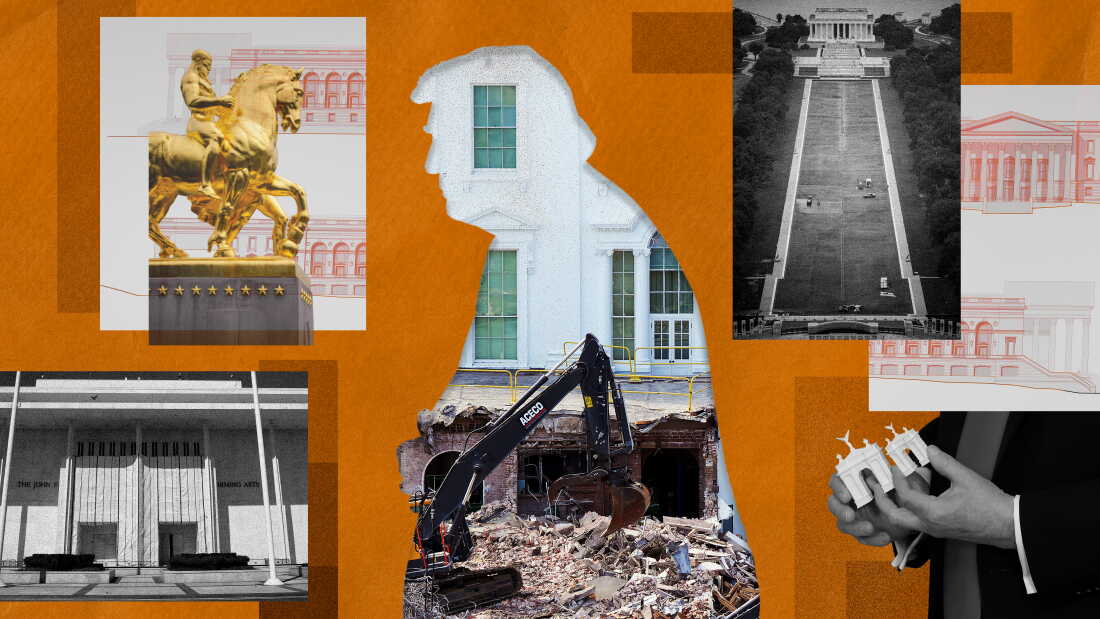
Trump tore down the East Wing of the White House to build an even bigger ballroom (and military complex underneath). He built a helipad on the South Lawn after separately paving over the Rose Garden. He had the Lincoln Memorial Reflecting Pool repaved in “American flag blue,” a project that was supposed to take two weeks but is still unfinished many months later, after a botched installation and several unfounded arrests.

He’s had new statues installed and existing ones restored, including two equestrian statues glaringly gilded over the summer. He wants to build a sculpture garden of “national heroes” in West Potomac Park and overhaul the locally beloved East Potomac Golf Links, changing it from a municipal resource into a championship-level venue.
The list goes on. Trump seeks to add his name to the Kennedy Center building, or else have it demolished altogether. He’s trying to fast-track a controversial 250-foot arch near Arlington National Cemetery, most recently rebranding it as a military complex — despite originally telling reporters it was intended to honor “me.”
“I have heard the president say: ‘I am president because I am rich. I am rich because I am a developer. I am a developer because I have exquisite taste,'” said Greg Werkheiser, whose law firm, Cultural Heritage Partners, is involved in several lawsuits against Trump’s projects. “It would appear that much of his self-worth is tied to this mythology of Trump as a builder.”
White House spokesperson Davis Ingle told NPR in a statement that “President Trump can walk and chew gum at the same time,” saying he is delivering on campaign policy promises while also “ensuring the People’s House and our Nation’s Capital will be properly glorified and remain in excellent condition for generations to come.”
“Thanks to the Builder-in-Chief, no other president has done more to beautify our Nation’s interior than President Trump,” he added.

Side-by-side construction of a new helipad on the South Lawn of the White House and the East Wing ballroom, as seen in late August.
Andrew Harnik/Getty Images
hide caption
toggle caption
Andrew Harnik/Getty Images
Trump’s second-term projects have prompted lawsuits, protests and tens of thousands of public comments overwhelmingly in opposition. While some of these undertakings are pegged to the country’s 250th anniversary, critics have long accused the president of rushing to memorialize himself out of fear that no one else will. And Trump confirmed as much in a New York Magazine piece published earlier this month.
“Nobody will do it once I’m gone,” said the 80-year-old, second-term president. “When I leave here, nobody will.”
Trump and those in his orbit maintain he is uniquely qualified to put his stamp on D.C. because of his decades-long career as a New York City real estate developer. Then-White House press secretary Karoline Leavitt told Fox News last year that “in large part, he was reelected … because he is good at building things.”

But people who worked with him at the time point out that his early-career building projects and strategies were fraught too, boosted by financial workarounds and plagued by lawsuits. And, more broadly, historians and legal experts worry that Trump is setting a dangerous precedent by treating D.C. as his personal construction playground.
“The worse his approval ratings, the economy and the war get, the more time he spends in the sandbox playing with America’s historic sites as if they were his personal toys,” Werkheiser said.
Barbara Res, who served as head of construction for the Trump Organization in the 1980s, says Trump’s efforts to cut corners with ambitious projects are not new, but take on a painful significance in a moment when he is “ripping through” the nation’s capital.
“There was no regard for the law back then. But he wasn’t the king of the world; he wasn’t the president,” Res said. “Now he has no regard for law … and he gets away with it.”
A history of disregard for historic preservation

Trump, pictured in 1985, displays an artist’s concept of “Television City,” a proposed real estate development on Manhattan’s Upper West Side that was ultimately never built in part due to community opposition.
Marty Lederhandler/AP
hide caption
toggle caption
Marty Lederhandler/AP
Res, who left the Trump Organization in 1998, stressed that there is a big difference between a builder and a developer.
Trump was the latter, overseeing big-picture decisions like hiring architects, engineers and contractors. Even so, she said he often made demands about details that usually made the job harder, such as telling crews to reuse old HVAC equipment in new ductwork as a cost-cutting measure.
“His father was a builder in Brooklyn … and Donald seems to think that gives him credibility as a builder, ’cause he walked around with his father,” she said. “Maybe he does now, but when we were doing the work, he didn’t really know much about construction.”
Res is an outspoken Trump critic: in 2020, she published the book Tower of Lies: What My 18 Years of Working with Donald Trump Reveals About Him. She concedes that “he did do good things” for real estate, but that was before he was president.
“The White House and the capital are not to his credit, so I don’t think that would be part of his legacy,” she said. “Probably his most important building is Trump Tower.”
Trump Tower was Trump’s second major independent project, and his first built-from-scratch skyscraper. And it was marred by a historic preservation scandal before it even opened.
In 1979, Trump — then a budding developer in his early 30s — bought the flagship building of the Bonwit Teller luxury department on Manhattan’s Fifth Avenue, with plans to tear it down and build Trump Tower in its place.
Penelope Hunter-Stiebel was a curator at the Metropolitan Museum of Art at the time. When she heard of Trump’s plan to demolish the 1929 building, she jumped into action to save the historic artwork on its facade: two classical-style 15-feet-high limestone sculptures of nudes dancing with scarves, and a massive art deco decorative metal grille.

The Bonwit Teller Department store in New York City, with its art-deco sculptures framing the top row of windows before the balcony.
AP/AP
hide caption
toggle caption
AP/AP
Hunter-Stiebel believed the sharp contrast of two different architectural styles — added to the same building in the span of a single year — would make for a great addition to the Met’s collection. And she thought Trump could benefit, too.
“We had been chasing wrecking balls as buildings of architectural ornament that were significant were destroyed around New York,” she said. “I thought in this case, looking up Trump, it was a chance of changing the direction.”
Hunter-Stiebel approached the Trump Organization with an offer: “Young Donald,” as he was called, could not only get some positive PR for salvaging the artwork, but he could likely also get a tax deduction.

She said Robert Miller, who owned the gallery across the street, had agreed to appraise the works and valued them at around $200,000. He told The New York Times in 1980: “The reliefs are as important as the sculptures on the Rockefeller building. They’ll never be made again.”
Hunter-Stiebel says she reached an agreement with the Trump Organization. But shortly after scaffolding and demolition crews arrived in the spring of 1980, she noticed the metal grille had vanished (its whereabouts remain a mystery). Then came a panicked call from Miller, who spotted jackhammers across the street.
“[I] got in a taxi, and got in a classic New York City traffic jam, nothing moving down Fifth Avenue,” she recalled. “So I got out and I ran 10 blocks, which I remember because I was nine months pregnant.”
They decided that Miller — a less recognizable player in the drama — would approach the foreman, with cash he frantically collected from his employees, to try to save the sculptures.
Hunter-Stiebel says the foreman told Miller, who died in 2011: “The young Donald has said specifically that there’s this crazy woman at a museum up the avenue who wants them, and I have to be sure they’re absolutely destroyed.”
They watched in horror as the jackhammers went to work. As of 2016, at least one piece of the sculptures lived on the Miami balcony of former Trump Organization executive Louise Sunshine, who did not respond to NPR’s interview request.

There was immediate fallout from the incident. The New York Times ran a front-page story in which Trump Organization executive “John Baron” (now a well-known Trump alias) said removing them carefully would have cost more than three times their appraisers’ estimated value and delayed demolition by over a week. (Almost two decades later, in 1998, Trump paid $1.375 million to settle a class-action lawsuit involving the use of undocumented Polish laborers during that demolition.)
Res said Trump told her a different version of the story: He offered the sculptures to the Met, but was turned down. Because they were not “landmarked,” she said, “I don’t see anything wrong with that except lying about it.”
But to Hunter-Stiebel, the incident represents “Trump’s first experience of the negative delights of power.”
“I’m afraid we have seen the same behavioral pattern in large scale, and a strange delight in doing things that can only be destructive … including [to] the person making those decisions,” she added.
Acting not as a builder, but as an owner

President Trump shows an image of his planned ballroom in the Oval Office on Oct. 22, 2025.
Jim Watson/AFP via Getty Images
hide caption
toggle caption
Jim Watson/AFP via Getty Images
There’s a world in which Trump’s career experience as a developer could benefit D.C., said historian Tim Naftali, a professor at Columbia University’s School of International Public Affairs.
“But the president hasn’t acted just as a builder,” he said. “He’s acted as an owner, and that’s the difference. The president of the United States does not own the United States. The president of the United States doesn’t even own the White House.”
Naftali said previous presidents have all approached their White House role as custodians. That doesn’t mean they didn’t make changes: There’s a long history of presidents renovating the White House. But other than Truman, who paid for the second-story balcony with his government-funded “household account,” they all went to Congress for authorization and funding.

Trump has not done that for his building projects, even though his party controls both houses of Congress. Experts say that creates a dangerous precedent for future occupants of the White House.
“The building projects are simply a symptom of President Trump’s theory of government, which is that he alone is the federal government of the United States,” Naftali said.
Beyond the White House, Naftali said D.C.’s most iconic monuments — honoring George Washington, Abraham Lincoln, Thomas Jefferson and more — were built through “presidential inspiration mixed with congressional action.” Presidents angled for monuments honoring their predecessors, not themselves.
Naftali thinks of four-term president Franklin Delano Roosevelt, who made clear in his lifetime that the only memorial he wanted for himself was a small block of granite with his name on it.
“Yes, he pushed for a memorial, but it was the Jefferson Memorial,” Naftali added. “Not the ‘Jefferson Memorial brought to you by Franklin Delano Roosevelt.’ It was the Jefferson Memorial, built [and] financed by Congress.”
Charles Birnbaum, the CEO and founding president of The Cultural Landscape Foundation — which sued the administration over the reflecting pool — says Trump has made clear that “the sort of social norms and decorum that existed historically is no longer being applied.”
He noted, for example, that Trump has appointed non-expert allies to the federal arts panels tasked with reviewing D.C. construction. At the same time, the administration is also moving to roll back legal protections for historic places across the country.
“All of these proposals that we’re seeing, what they have in common is they’re not preserving and protecting. They are destroying, diminishing, altering,” said Birnbaum. “And that is where Washington is a case study right now of what this administration wants to export to the rest of the nation.”
When most recent presidents think about their legacy, Naftali said, they think about the work itself and, to some degree, the one building they expect will eventually bear their name: their presidential library, usually built outside of D.C. in a location of personal significance. Trump has said his — a planned skyscraper in Miami — will most likely be a hotel.
When it comes to shaping his own legacy, Trump has bucked presidential norms in many ways. Beyond his controversial construction projects, he’s the first sitting president to have an airport named after him, and the first in a century to have his face on currency.

And while these acts may seem relatively trivial at a time of broader economic and international turmoil, Naftali said, they should ring alarm bells to anyone who cares about the separation of powers. He suspects Trump may be eager to jam his projects through before the midterms, when the makeup of Congress may shift.
Trump told New York Magazine that the embattled White House ballroom will be made of “nuclear concrete,” saying it would physically be hard for Democrats to one day tear it down. The reporter of that story, Ben Terris, told NPR that Trump is “trying to cement his legacy, literally, and … make something that nobody can take away from him.”
But to Naftali and others, the greater risk is in what might be lost along the way.
“We Americans will pressure Congress in one way or another to do something with whatever is left of the building program once the president leaves office,” Naftali said. “The bigger issue is, do we want our separation of powers of doctrine to survive through our 300th birthday?”
