

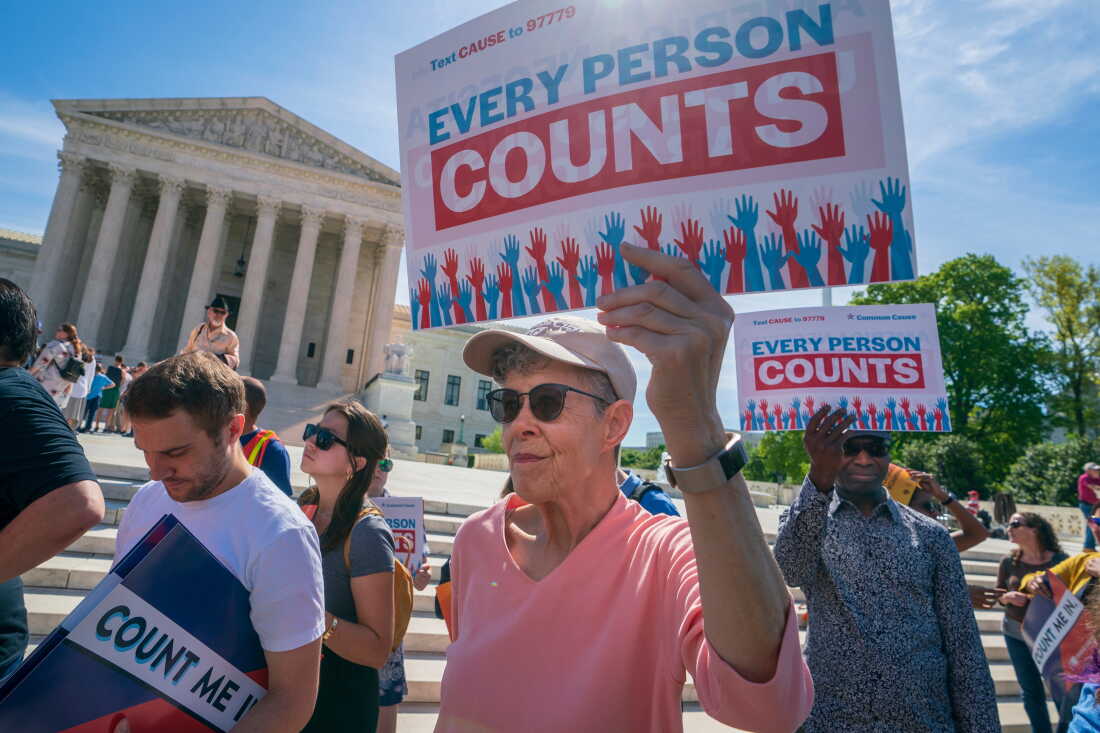

Demonstrators holding signs saying “EVERY PERSON COUNTS” rally outside the Supreme Court in 2019 in Washington, D.C., as the justices hear arguments over the first Trump administration’s failed push to ask about U.S. citizenship status on the 2020 census.
J. Scott Applewhite/AP
hide caption
toggle caption
J. Scott Applewhite/AP
The Trump administration is proposing major changes to how the U.S. government produces census results for the next national head count in 2030.
While the plan faces likely legal challenges, such changes would affect the population numbers used to determine each state’s share of representatives in Congress and votes in the Electoral College, redraw maps of voting districts for all levels of government and distribute federal funding for public services.
The administration’s proposal, which was released online Wednesday, calls for an unprecedented exclusion of non-U.S. citizens without a green card from a key set of 2030 census results that the 14th Amendment says must include the “whole number of persons in each state.”
Trump officials are also proposing to stop using the census to ask about people’s race and ethnicity, a topic that the national tally has included since the first count in 1790.
Many civil rights advocates, researchers and other supporters of the census race question warn the administration’s plan puts at risk future federal data used for redistricting, enforcing the Voting Rights Act and other antidiscrimination protections and informing policymaking.
Another key part of the proposal would ban the U.S. census from including a question about people’s sexual orientation.
While the government has not directly asked about that topic before on census forms, the 2020 count did ask couples living together to describe their partners as either “opposite-sex” or “same-sex.” The first Trump administration blocked an earlier effort to add a sexual orientation question to the Census Bureau’s American Community Survey, which the Justice Department under Democratic administrations has said is needed, alongside a gender identity question, to generate statistics that could help protect LGBTQ+ people from discrimination.
The administration’s proposal comes months before it is supposed to send a report by April 1 on the proposed question topics for the 2030 census to Congress, which has final authority over the count under the Constitution.
How Trump officials want to change who gets counted in the 2030 census
While the country’s past tallies beginning in 1790 had specific instructions from the Constitution about how to count enslaved people and not to count “Indians not taxed,” the U.S. census has never left out residents because of their immigration status.
That kind of change would also have ripple effects on public policymaking, scientific research and business decisions that rely on data from the once-a-decade census.
But this latest push by Trump officials faces constitutional hurdles, as well as the possibility of a new presidential administration reversing any changes to 2030 census plans after coming into office in 2029.
The proposal comes after President Trump put out a social media post in August 2025 that directed his administration to start work on a “new” census amid a congressional gerrymandering fight that he started. Trump called for the count to leave out millions of people living in the U.S. without legal status. According to the Constitution, the president does not have final authority over the census.
Before Trump’s first term ended in 2021, his administration tried and failed to add a census question about U.S. citizenship status. Trump also failed to carry out his bid to subtract U.S. residents without legal status from the 2020 census apportionment counts that are used to redistribute congressional seats and Electoral College votes among the states.
As the current Trump administration pushes for census changes, Republican lawmakers in Congress are backing similar proposals to exclude some or all noncitizens in recent years.


And some GOP-controlled states have filed lawsuits that call for residents without legal status and those with nonimmigrant visas to be left out of census numbers. One of those states is Missouri, where that kind of change to census results could lead to a radical shift in state legislative redistricting that moves political power away from younger, more racially diverse urban areas and toward older, whiter rural areas.
Many census advocates are concerned that, even if not ultimately carried out, the Trump administration’s latest call for major changes to the national head count could further dampen public participation in the 2030 census, especially among Latino residents whom the Census Bureau has historically undercounted.
With little explanation earlier this year, the administration made last-minute changes to a field test of the upcoming tally. Among them was using a survey form, unrelated to the census, with a citizenship question that the bureau’s own research shows is likely to hurt the count’s accuracy.
How the Trump proposal would affect racial and ethnic statistics from the census
The administration’s proposal for the 2030 census not to ask about people’s race and ethnicity comes after a White House agency official revealed last year that the administration was reconsidering the changes made to the U.S. government’s standards for racial and ethnic data under former President Joe Biden.
Almost a decade ago, the first Trump administration stalled an earlier process for revising those standards in time for the 2020 census. That decision came after Census Bureau research and public discussion about what kind of survey questions and checkboxes about race and ethnicity would produce statistics that are more in line with how people see their identities today.
The Biden administration revived that review and ultimately in 2024 revised the standards for the first time in more than a quarter-century.
Among the Biden-era changes to federal surveys were new checkboxes for “Hispanic or Latino” and “Middle Eastern or North African” under a reformatted question that asks survey participants: “What is your race and/or ethnicity?” That change would end the use of a separate question about Hispanic or Latino identity, which the federal government has long considered to be an ethnicity that can be of any race. Another key revision would stop requiring the government to automatically categorize people who identify with Middle Eastern or North African groups as white.

Census Bureau research suggests those changes would better reflect many people’s identities and help produce statistics that represent the country’s demographics more precisely.
The move to use a combined question about race and ethnicity was mainly driven by the rise of “Some other race” as the preferred response to past census questions about race for many Latinos. That trend has produced imprecise racial data that has made it harder to enforce anti-discrimination laws. Some researchers, however, have raised concerns about a combined question’s potential effects, including the risk of blurring the distinctions between race and ethnicity and flattening statistics about Afro Latinos.
The revisions also had vocal opponents at The Heritage Foundation, the right-wing, Washington, D.C.-based think tank. The “Project 2025” policy agenda it released said a “conservative” administration should “thoroughly review any changes” to census race and ethnicity questions because of “concerns among conservatives that the data under Biden Administration proposals could be skewed to bolster progressive political agendas.”
Last year, with no explanation, the White House’s Office of Management and Budget pushed back the deadline to Sept. 28, 2029, for federal agencies to get their forms in line with the Biden-era changes. OMB has also extended the deadline twice for agencies to release public action plans for those forms, which were previously due this past March.
Some agencies have already changed their surveys.
But in May, the Census Bureau stopped plans to revise its largest survey — the American Community Survey — in 2027, citing the Trump administration’s latest deadline extension for agency action plans. The form for the “2026 Census Test” that the bureau concluded on Aug. 31 in Huntsville, Ala., and Spartanburg, S.C., to prepare for the 2030 census used the same questions about race and ethnicity from the 2020 count.
Edited by Benjamin Swasey

