

Most radio stations are using AI somewhere in their workflow now, and that’s a good thing. It might be drafting the first version of a news story, summarizing a long interview, writing show prep, cleaning up audio or making a quick image for a news post. None of that is a problem on its own. Used well, AI saves a small staff a lot of time, especially at small market stations.
The problem is that your listeners don’t know any of that is happening, and they’re getting more skeptical about how businesses use AI. Scroll through any social media feed and you’ll see why. So much of it is AI-generated now that people are getting tired of it.
Why Listeners Care How Your Station Uses AI
The Bentley-Gallup Business in Society survey found that only 27% of Americans trust businesses to use AI responsibly, down from 31% the year before. Another 39% now say AI does more harm than good. The people answering those questions are your listeners, and some of them are your advertisers.
Radio has always been about people. Listeners know your personalities’ voices. They recognize your news people when they see them around town. They assume a person stands behind what your station puts out, on the air and on your website.
You’ve probably seen that iHeartMedia now tells listeners its stations are “Guaranteed Human.” According to Radio Ink, the policy rules out AI-generated on-air personalities and synthetic music, while staff can still use AI productivity tools behind the scenes. You don’t have to make a pledge like that, but it shows how much the human part matters to listeners right now.
Think about what happens when someone discovers on their own that an image in one of your news stories came from AI. They start wondering what else on your website, or on the air, is AI-generated. That conversation goes a lot better if they hear it from you first.
What Your AI Policy Page Should Say
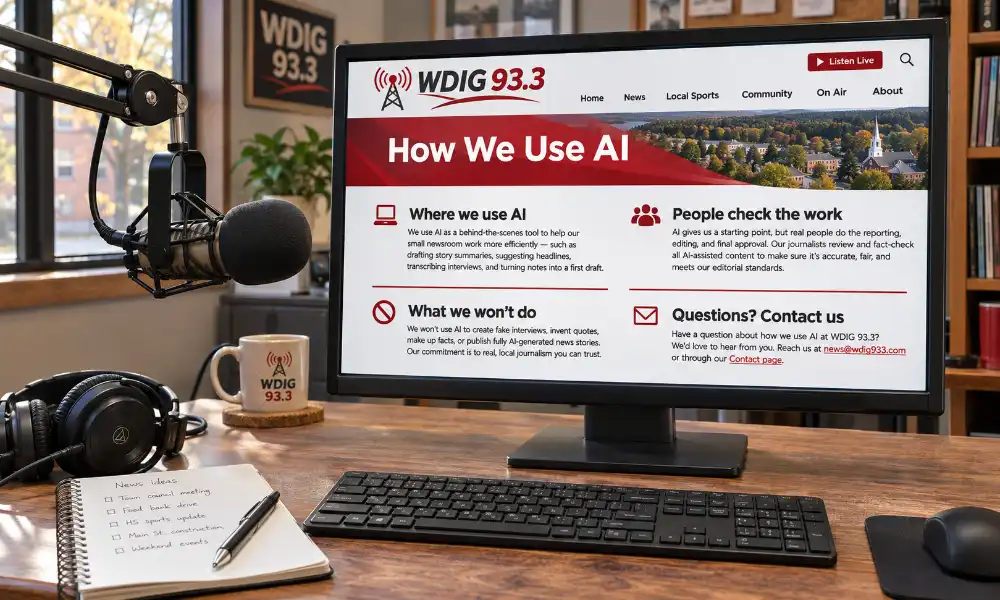
An AI policy page was one of the first things I created when I recently built a hyperlocal news website for the area around our offices. I wanted readers to know that yes, we use AI, but everything it produces filters through us before it gets to them.
The page doesn’t have to be a legal document. It’s a short explanation of how your station uses AI, written the way you’d explain it to a listener who called the station and asked. Link it in your website footer next to your privacy policy, terms of use and FCC public file link, and link to it from your About page so people can find it easily.
The page answers four questions, and the outline below has sample wording for each. Be specific about where you use AI, and spend the most care on where a person always checks, because that’s the part listeners care about most.
One sentence can do a lot of work here. Say your newsroom uses AI to turn a two-hour city council recording into a first draft. Your policy says a reporter checks the names, numbers and quotes against the recording before anything goes up. That one line tells a reader exactly how much to trust what they’re reading.
Then put a date on the page and update it whenever your tools change. A policy that still mentions a service you stopped using years ago doesn’t build much confidence in everything else on your website.
An AI Policy Page Outline You Can Copy
Here’s the outline I promised in the episode. Replace the brackets with your own details, cut anything that doesn’t apply and write the rest the way your station talks.
Page Title and Opening
How [Station Name] Uses AI
[Station Name] uses AI tools to help our team work faster, but people decide what you hear on the air and read on our website. Here’s where we use AI, where a person always checks the work and how to reach us.
The Four Questions
- Where do we use AI?
“We use AI tools to help draft news stories from our own recordings, write transcripts, summarize public meetings, translate stories and create some illustrations for our posts.” - Where does a person always check?
“A member of our team reviews every story before it’s published. We check every name, date, number and quote against the original recording or source.” - What won’t we do?
“We won’t use AI voices to imitate our hosts. We won’t publish quotes that nobody said. We won’t pass off an AI-generated image as a real photo of a real event.” - Who can someone contact?
“Questions or corrections? Email [[email protected]] or call [phone number], and we’ll take a look.”
Finish the page with a date line: “Last updated [Month Year]. We update this page whenever our tools change.”
Disclosure Lines for Stories and Images
- At the end of a story AI helped draft: “This story was drafted with the help of AI and reviewed by our news team.” Link that line to your AI policy page.
- In the caption of an AI image: “Illustration created with AI (ChatGPT). Not a photo of a real event.”
Label the Content Itself
The policy page is the easy part. What makes it believable is what happens on each individual story.
Google’s guidance on helpful content asks whether the use of automation, including AI, is “self-evident to visitors through disclosures” or in some other way. Google says disclosures are useful when someone might ask, “How was this created?” So label the content itself. At the bottom of a news story AI helped draft, add one plain line like the sample above, and link it to your policy page.
Do the same with images. If you made an illustration with AI, say so in the caption, especially if it could be mistaken for a real place or event in your town. We talked about AI images back in episode 168, and the same idea applies here.
On our own websites, every image caption says where the image came from. It’s one of the best practices we teach every new affiliate, because five or ten years from now you won’t remember which service you downloaded it from. I do the same with AI. If I generate an image in ChatGPT or another AI tool, the caption says so, which covers you on trust and tells you later where it came from.
The same Gallup research shows why the label matters. About three in four people find it acceptable for AI to help brainstorm or draft an ad, as long as that use is disclosed. But 62% find AI-created people or voices in advertising unacceptable even when it’s disclosed. Being upfront helps with AI that works behind the scenes. A fake person is the line most people don’t want crossed, label or not.
That number is about advertising, but I’d use the same caution with images on your website. When you need an illustration, make it a generic scene rather than people walking down a street in your town. You don’t want a reader to spot someone with a hand coming out of their head.
Sell the Human Touch
Your policy page can do more than protect you. It can help you sell. Your local advertisers read the same headlines your listeners do, and they probably share the same opinions. In that same survey, 49% said they view businesses’ use of AI to create advertising negatively. Radio Ink pointed out that this makes real voices and real local talent a selling point, and your policy page backs that pitch up.
Picture your salesperson sitting down with a car dealer or a restaurant owner and telling them that real people will read their ads, and real people stand behind the content those ads run next to. That turns something listeners and advertisers worry about into a reason to advertise with you, or to keep advertising longer.
If you use AI in your own commercial production, decide how you’ll tell clients about it before an advertiser asks. If you’re using it properly and you’re upfront about it, it can add value for the client instead of raising questions.
Key Takeaways
- Most stations already use AI somewhere. Tell listeners where before they find out on their own.
- A short AI policy page answers four questions: where you use AI, where a person always checks, what you won’t do and who to contact.
- Link the page in your footer and from your About page, and put a date on it.
- Label AI-assisted stories and AI images where people see them, and keep AI-created people out of it.
- Give your sales team the policy. Real people reading ads is part of the pitch.
Do This This Week
Sit down with your team and list every place your station uses AI that listeners or clients can see: the website, the air, the newsroom, production, sales and social media. Internal work like production orders doesn’t need to be on it. Next to each item, write down who checks the work after AI drafts it. That list is the first draft of your policy page.
Frequently Asked Questions
Does an AI policy page have to be a legal document?
No. It’s a short, plain explanation of how your station uses AI, written the way you’d explain it to a listener who called and asked. If you have legal questions about AI or disclosure, talk with your station’s attorney.
Do we need to label everything AI touches?
Label what listeners and clients see, like stories AI helped draft and images AI created. Behind-the-scenes uses such as production orders don’t need a label.
Should we use AI images that show people?
I’d avoid it. Use AI for generic scenes instead, and say so in the caption. In the Bentley-Gallup survey, 62% found AI-created people or voices in advertising unacceptable even when disclosed.
How often should we update the page?
Put a date on it, and update it whenever your tools change.
Related Episodes
If you’d like help building your AI policy page, or anything else on your station website, reach out to us.
We want to help your radio station grow and succeed online. That journey starts with an amazing website that keeps visitors coming back often. Reach out to us to start your path to online success, or schedule an appointment to see our tools in action.
