

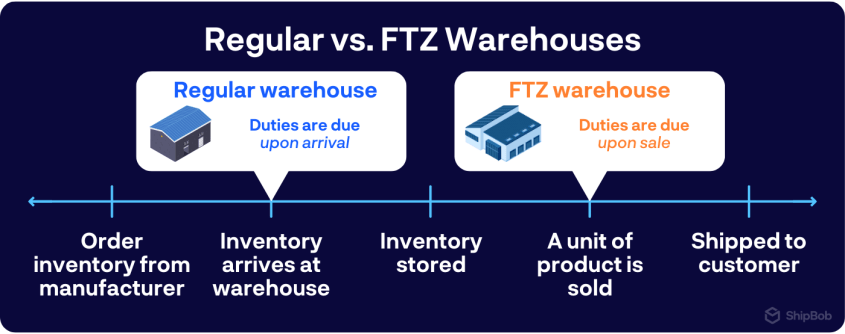
Apparel brands importing inventory into the US are facing a margin crisis. Tariff rates on clothing and textiles have climbed steadily, with duties ranging from 10% to over 30%. The exact rate depends on fiber content, country of origin, and product classification.
For brands moving thousands of units per month, those costs add up fast.
Foreign-Trade Zones (FTZs) offer apparel brands a practical, legal path to defer, reduce, or eliminate duties on imported inventory. Major retailers and manufacturers have used them for decades, and they’re increasingly accessible to mid-market DTC and omnichannel brands.
In this article, you’ll learn what FTZs are and how they create specific cost savings for apparel importers. You’ll also see how they compare to other tariff-reduction strategies and how to integrate FTZ fulfillment into your broader supply chain.
What is a Foreign-Trade Zone?
A Foreign-Trade Zone is a designated area within the US where imported goods are legally treated as if they’re outside US customs territory.
Goods can be stored, handled, tested, relabeled, repackaged, and even fulfilled from an FTZ without triggering duty payments.
Duties aren’t owed until goods formally enter US commerce. That means they’re triggered when goods ship to a domestic customer or transfer to a non-FTZ location. If goods are exported, destroyed, or disposed of while still in the zone, no duties are owed at all.
The primary advantages of FTZ designation include:
- Duty deferral: Pay duties only when goods leave the zone and enter US commerce.
- Duty elimination: Avoid duties entirely on goods that are re-exported, scrapped, or destroyed.
- Inverted tariff relief: Elect a lower duty rate on finished goods when the rate on components is higher.
- Weekly entry filing: Consolidate customs entries into a single weekly filing instead of filing per shipment.
- Ad valorem tax exemption: Inventory stored in an FTZ may be exempt from state and local ad valorem taxes.
FTZs are authorized by the Foreign-Trade Zones Board, a joint body of the US Department of Commerce and the US Treasury. US Customs and Border Protection (CBP) supervises them. There are hundreds of FTZ sites across the US, operated by a mix of public and private entities.
How apparel import tariffs squeeze margins
Tariffs on apparel are an active, growing cost that directly erodes profitability for brands importing finished garments and textiles into the US.
Duty rates on apparel are already high; the exact rate depends on factors like fiber composition (cotton vs. synthetic), garment type (knit vs. woven), and country of origin, but apparel brands can expect to pay more in duties than other industries.
Tariff escalations targeting imports from China and Vietnam have pushed effective rates even higher for many categories.
The suspension of de minimis exemptions for certain countries has also made it harder for brands to avoid duties on lower-value shipments.
Passing those costs to customers through price increases isn’t a reliable strategy for most apparel brands. Fashion-conscious shoppers are price-sensitive. Competitive pressure from fast-fashion and marketplace sellers also limits how much you can raise prices before demand drops.
The cash flow impact is equally painful. Most apparel brands pay duties upfront when inventory clears customs, often months before a single unit sells.
A brand importing $2 million in fall inventory in June ties up hundreds of thousands of dollars in duty payments before the selling season even begins.
Apparel brands selling in the UK, Europe, Australia, Canada, and the US all face varying tariff regimes that complicate cross-border operations. For omnichannel brands managing inventory across multiple markets, the cumulative tariff burden can become one of the largest line items on a P&L.
How FTZs reduce costs for apparel brands specifically
FTZs address cost drivers that are uniquely painful for apparel importers. Seasonal inventory cycles, high markdown rates, and international redistribution all create opportunities for savings. Here’s how each savings driver works for apparel brands.
Seasonal inventory and duty deferral
Apparel operates on long lead times and compressed selling windows. Brands typically import large quantities of seasonal inventory months before the selling season starts. Without an FTZ, duties are due at the time of import, regardless of when (or whether) those goods sell.
Inside an FTZ, duties are deferred until goods actually leave the zone and enter US commerce. A brand can import its entire fall collection in June and pay duties incrementally as orders are fulfilled through September, October, and November.
Example
Consider a brand importing $2 million worth of fall inventory in June at a 20% duty rate. That’s $400,000 in duties.
Without an FTZ: That entire amount is due upfront.
With an FTZ: You pay duties only as units ship to customers. The $400,000 spreads across the entire selling season, preserving cash flow for marketing, operations, and growth.
Re-exports and international redistribution
When goods stored in an FTZ ship to a destination outside the US, no US duties are owed. This makes FTZs especially valuable for omnichannel apparel brands that use a US-based hub to serve international markets.
A brand fulfilling orders to Canada, the UK, or Australia from a US FTZ location pays zero US duties on those shipments. For brands with international wholesale or marketplace channels, this benefit compounds quickly. Every unit that ships internationally from the FTZ represents a complete duty savings on the US side.
This approach is particularly effective for brands consolidating global inventory in one location before distributing to multiple markets.
Unsold, obsolete, and damaged goods
Apparel has some of the highest markdown and write-off rates of any product category. Seasonal trends shift, sizes don’t sell evenly, and quality issues can surface after goods arrive at a warehouse.
Inside an FTZ, you can destroy or dispose of unsellable inventory without ever paying duties on it. This applies to damaged goods, defective items identified during quality inspection, and end-of-season inventory that won’t be sold domestically.
Weekly entry filings and reduced processing fees
Standard customs procedures require a separate entry filing and Merchandise Processing Fee (MPF) for each individual shipment clearing customs. For brands receiving frequent inbound shipments, those fees and administrative costs stack up.
FTZs consolidate customs entries into a single weekly filing, regardless of how many individual shipments entered the zone that week. This reduces both the per-entry MPF charges and the administrative workload of managing multiple customs entries.
The savings scale directly with shipment frequency. A brand receiving five inbound shipments per week goes from five separate entry filings and five MPFs to one of each.
Inverted tariff relief for finished goods
In some apparel categories, the duty rate on a finished garment is actually lower than the rate on the individual components or raw materials used to make it. This inversion creates an opportunity inside an FTZ.
Under FTZ rules, you can elect to pay the duty rate on the finished product rather than the rate on the components. For categories where this inversion exists, the savings can be significant.
This benefit requires proper Harmonized Tariff Schedule (HTS) classification and isn’t available for all apparel categories. Work with qualified trade counsel to determine whether your specific products qualify.
What FTZs don’t do
FTZs are a powerful tool, but they do have clear limitations. Understanding those boundaries helps you set realistic expectations and build the right strategy.
❌ FTZs don’t lower the actual duty rate on goods sold into the US. If the tariff on a cotton T-shirt is 16.5%, that rate applies whether the shirt is stored in an FTZ or a standard warehouse. The FTZ defers when that duty is paid, not how much.
❌ Operating within an FTZ involves additional overhead. Inventory inside an FTZ must be tracked at a granular level, and recordkeeping requirements are more rigorous than standard warehousing.
❌ FTZ authorization is held by the zone operator or a third party, not by the brand itself. You access FTZ benefits through your fulfillment or logistics partner’s existing authorization.
💡 The benefits of an FTZ scale with volume. Brands with lower import volumes may find that the administrative costs outweigh the duty deferral and other savings. FTZ fulfillment tends to deliver the strongest ROI for brands moving high volumes of imported goods.
FTZ vs. other tariff-reduction strategies for apparel brands
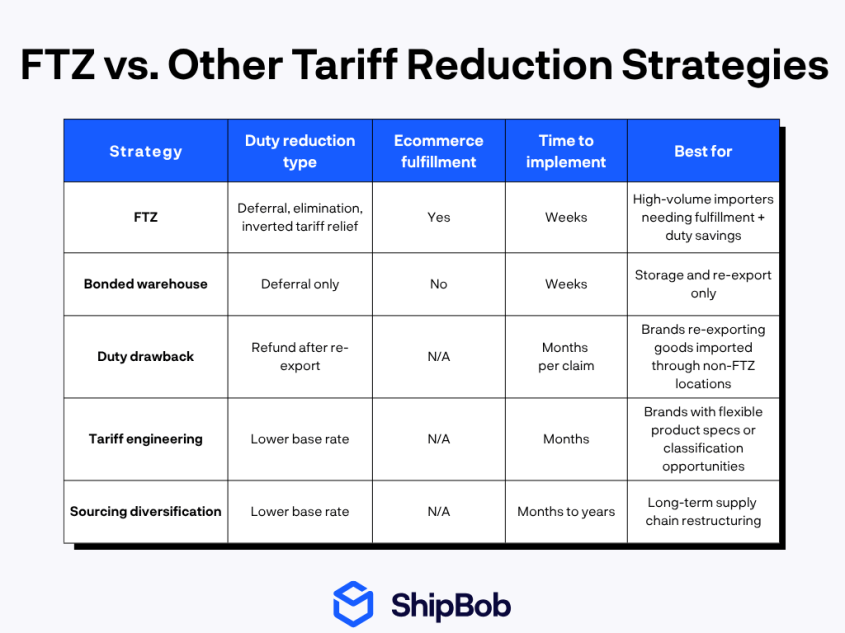
FTZs are one piece of a broader tariff strategy. Here’s how they compare to other approaches apparel brands commonly consider.
Bonded warehouses
Bonded warehouses also defer duties on imported goods, but they come with more restrictions than FTZs. Goods in a bonded warehouse must be exported or have duties paid within a set time limit (typically five years). The flexibility around what you can do with inventory inside the facility is also more limited.
FTZs allow indefinite storage, support DTC fulfillment from within the zone, and offer weekly entry filing. However, bonded warehouses don’t support ecommerce order fulfillment, which makes them a poor fit for DTC or omnichannel apparel brands that need to pick, pack, and ship individual orders.
For brands focused on ecommerce fulfillment, FTZs are generally the more practical option.
Duty drawback
Duty drawback is a refund mechanism. Brands that import goods, pay duties, and later re-export those goods (or substitutable goods) can apply for a refund of the duties originally paid.
The challenge is speed and complexity. Drawback claims can take months to process and require detailed documentation linking imported goods to exported goods. The administrative burden is significant.
Duty drawback can complement an FTZ strategy for brands that import through non-FTZ locations and later export goods. But for brands that can route imports through an FTZ from the start, duty elimination on re-exports is automatic and immediate.
Tariff engineering and HTS optimization
Tariff engineering involves structuring products or their classification to qualify for a lower HTS code and a lower duty rate. This might mean adjusting fabric composition, garment construction, or packaging to shift into a more favorable tariff category.
This approach is legal but requires specialized trade counsel to execute properly since misclassification carries penalties.
Tariff engineering is complementary to FTZ usage. You can optimize your HTS classifications to reduce base duty rates and use an FTZ to defer or eliminate whatever duties remain.
Sourcing diversification and nearshoring
Some brands respond to tariff pressure by shifting production to lower-tariff-rate locations or nearshore markets like Mexico or Central America. This can reduce duty exposure, but it involves trade-offs. Lead times, quality control, minimum order quantities, and supplier relationships all factor in.
Sourcing diversification is a long-term strategic decision that takes months or years to execute. FTZ fulfillment for ecommerce apparel, by contrast, can be implemented in weeks and delivers near-term tariff relief while you evaluate or transition your sourcing strategy.
The strongest approach for most apparel brands combines both. Use an FTZ now to protect margins on existing supply chains while exploring sourcing diversification as a longer-term play.

How ShipBob’s FTZ solution fits into an omnichannel apparel fulfillment strategy
An FTZ works best when it’s integrated into a broader fulfillment strategy, not treated as a standalone customs tactic.
The most effective model for apparel brands is a hub-and-spoke approach. Bulk inventory enters the country through an FTZ-designated fulfillment center, where it’s stored duty-deferred. Inventory then feeds regional nodes across the country for DTC, marketplace, and B2B fulfillment. From there, duties are triggered only as goods leave the FTZ and enter commerce.
ShipBob operates bi-coastal FTZ fulfillment centers that give apparel brands access to:
- Duty deferral until sale: Pay duties only when orders are fulfilled and goods enter US commerce.
- Duty elimination on re-exports and disposals: Ship internationally or dispose of unsellable inventory without paying US duties.
- Inverted tariff relief: Elect finished-goods duty rates where applicable.
- Weekly entry filings: Reduce customs processing fees and administrative workload.
- Apparel-specific workflows: Branded packaging (brands provide their own boxes and mailers), kitting as a value-added service, and returns with modular refurbishment options including lint rolling, re-bagging, re-tagging, and re-barcoding.
True Classic, one of the fastest-growing apparel brands in the US, onboarded over 9,000 SKUs in two months with ShipBob and fulfilled 300,000 peak-season orders.
That kind of scale requires a fulfillment partner with apparel expertise, FTZ infrastructure, and the operational capacity to handle high-volume seasonal demand.
ShipBob handles CBP filings, inventory reporting, and SKU-level traceability through a managed model, so you don’t need to build FTZ expertise in-house.
Note: FTZ authorization may be held by third parties operating under contract with ShipBob.
To learn more about how ShipBob can help your apparel brand leverage FTZ warehousing, click the button below to get in touch.
FTZ for apparel brands FAQs
Here are answers to some of the most common questions about FTZ for apparel brands.
What is a Foreign-Trade Zone and how does it differ from a bonded warehouse?

A Foreign-Trade Zone is a designated US area where imported goods are treated as outside customs territory. This allows duties to be deferred, reduced, or eliminated. Unlike bonded warehouses, FTZs allow indefinite storage, support direct-to-consumer order fulfillment, and offer weekly entry filing. Bonded warehouses have time limits on storage and don’t support ecommerce fulfillment.
Can small or mid-size apparel brands benefit from an FTZ?
Yes, though the benefits scale with volume. Brands with higher import volumes and shipment frequency see the strongest ROI from duty deferral, weekly entry filings, and duty elimination on re-exports or disposals. Mid-size brands moving meaningful volumes of imported apparel can see significant savings, especially during peak seasons.
Do FTZs lower the actual tariff rate on apparel sold in the US?
No. FTZs don’t change the duty rate itself. They change when duties are paid (deferral) and whether duties are paid at all (elimination on re-exports and disposals). In some cases, FTZs also affect which rate applies (inverted tariff relief on finished goods). The base tariff rate for goods entering US commerce remains the same.
How quickly can an apparel brand get started with FTZ fulfillment through ShipBob?
ShipBob’s FTZ fulfillment centers are already authorized and operational, so you don’t need to apply for your own FTZ designation. Onboarding timelines depend on SKU count, inventory volume, and operational complexity. ShipBob has demonstrated the ability to onboard thousands of SKUs in a matter of weeks.
How does ShipBob ensure inventory accuracy inside an FTZ?
FTZ operations require granular inventory tracking and reporting to CBP. ShipBob’s warehouse management system maintains SKU-level traceability throughout the fulfillment process, from inbound receiving through storage, picking, packing, and shipment. All apparel at ShipBob is required to be bagged and barcoded, supporting accurate tracking at every stage.
What does ShipBob’s onboarding process look like for apparel brands moving to FTZ fulfillment?
ShipBob assigns a dedicated onboarding team that works with your brand to map SKUs, configure fulfillment workflows, and coordinate inbound inventory transfers. The process includes setting up apparel-specific requirements like barcoding, kitting configurations, and returns workflows with modular refurbishment services. ShipBob handles CBP filing setup and inventory reporting configuration as part of the managed FTZ model.
