
Most Indian sellers learn about EPR requirements the hard way. An Indian skincare brand gets its first wave of orders from Germany through its Shopify store. A month later, a marketplace listing for the same serum gets suspended. The reason has nothing to do with the product itself. It’s the cardboard box, the glass bottle and the paper leaflet inside, because nobody registered them for recycling in Germany.
That is what EPR is about. Extended Producer Responsibility rules make sellers pay for the waste their products and packaging create in the country where they’re sold. Most European countries apply them strictly, and they apply them to cross-border sellers too, including Indian D2C brands that ship straight to European customers.
This guide explains EPR requirements for selling in Europe in plain terms. It covers the three main categories, why one registration never covers every country, what changed with the new EU packaging rules in 2026, and a worked example for cosmetics and electronics sold into Germany and France. It ends with a checklist you can run before your next shipment.
What Is Extended Producer Responsibility?
Extended Producer Responsibility is a policy that shifts the cost of waste from taxpayers to the businesses that put products on the market. If you sell a product in a box, you help pay for collecting and recycling that box once the customer throws it away.
In practice, EPR requirements usually involve four obligations:
- Registration: you register as a producer with a national register or authority before you sell.
- Joining a scheme: you sign up with a producer responsibility organisation, or PRO, that organises collection and recycling on behalf of many producers.
- Reporting: you report the quantity of packaging or products you placed on the market, usually by material and weight.
- Paying fees: you pay the PRO a fee based on what you reported, often with lower fees for packaging that’s easier to recycle.
Who counts as a “producer”?
This is where many Indian sellers get caught out. In EU law, the “producer” is not necessarily the factory that made the product. It’s usually the business that first makes the product or packaging available in a given country.
If you sell directly to a consumer in Europe from India, through your own website or as the seller of record on a marketplace, you are very often the producer for that country. That holds even though you have no office, warehouse or staff there. If you sell to an EU importer or distributor who brings the goods in under its own name, that importer is usually the producer instead. Make sure your contract says who takes on EPR.
EPR requirements in India vs Europe
Many Indian sellers already know EPR from home. India has EPR for plastic packaging under the Plastic Waste Management Rules, managed through the Central Pollution Control Board’s portal, and separate rules for e-waste and waste batteries.
The European version follows the same idea, but don’t assume your Indian EPR registration counts for anything in Europe. It doesn’t. European EPR is run country by country, with its own registers, PROs, reporting cycles and fees.
Why European Countries Require EPR Registration
Europe uses EPR to hit recycling targets set at EU level. EU law sets the framework and the targets. Each member state then builds its own system to meet them: who registers, where, how data is reported and what fees apply.
For governments, EPR solves a practical problem. Online sales mean millions of parcels arrive from sellers based outside the country. Without EPR, the packaging from those parcels ends up in local bins while the seller pays nothing towards recycling it. Domestic brands that do pay would be at a disadvantage.
That is why European regulators, and the marketplaces that operate there, now treat foreign online sellers the same as local ones. “We ship from India” is not an exemption.
The Three Main EPR Categories for Indian Sellers
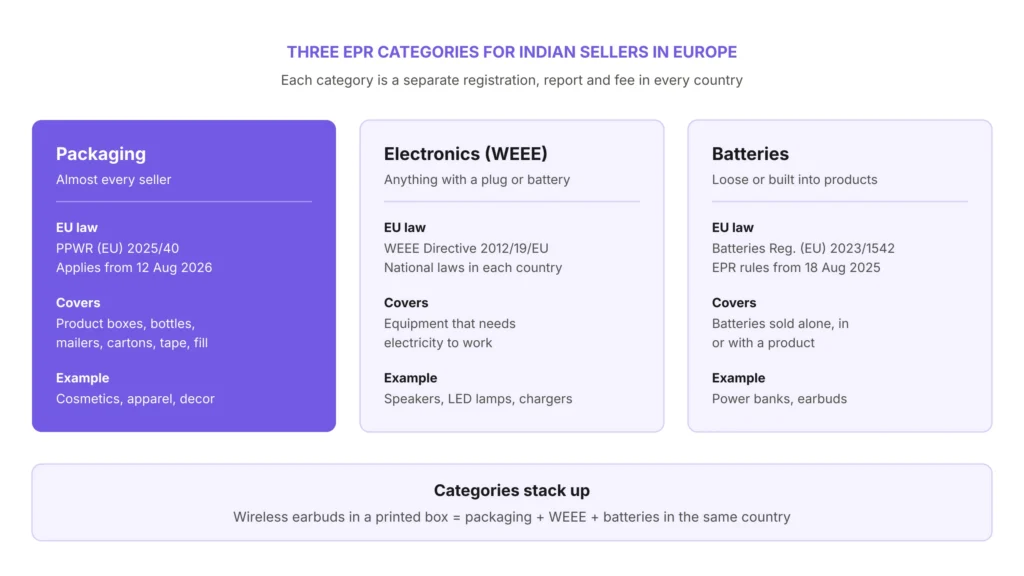
Europe has EPR schemes for several product streams. Some countries add more, such as textiles, furniture or toys in France. For most Indian eCommerce businesses, three categories matter most, and each one is a separate obligation.
| Category | Main EU law | What triggers it | Typical Indian products |
|---|---|---|---|
| Packaging | Packaging and Packaging Waste Regulation (EU) 2025/40, applies from 12 August 2026 | Any product sold in packaging, including shipping cartons, mailers and fillers | Every product shipped to consumers: cosmetics, apparel, home decor, food, handicrafts |
| Electrical and electronic equipment (WEEE) | WEEE Directive 2012/19/EU | Products that need electricity or batteries to work | Bluetooth speakers, LED lamps, kitchen appliances, chargers, smartwatches |
| Batteries | Batteries Regulation (EU) 2023/1542, EPR rules apply from 18 August 2025 | Loose batteries and batteries built into or sold with a product | Power banks, wireless earbuds, battery-powered toys, electric grooming kits |
Packaging EPR requirements
Packaging EPR is the one almost every seller has to deal with. If your product reaches a European consumer in a box, bag, bottle, tube or mailer, packaging EPR applies. That includes the outer shipping packaging, the tape and the void fill, not just the branded product box.
The EU’s Packaging and Packaging Waste Regulation, or PPWR, entered into force on 11 February 2025 and has applied since 12 August 2026. It replaced the old Packaging Directive with one regulation across the EU. It also sets future rules on recyclability: by 2030, all packaging on the EU market must be recyclable in an economically viable way.
What the PPWR does not do is create one EU-wide registration. EPR registration, reporting and fees for packaging are still handled in each member state.
WEEE: electrical and electronic equipment
If your product has a plug, a battery or a solar panel, it’s probably electrical and electronic equipment. The WEEE Directive requires producers to register in each member state where they sell and to finance the collection and recycling of products when they become waste.
The directive specifically covers distance sellers. A business that sells electrical equipment directly to households in a member state where it isn’t established, including a business based in India, has to appoint an authorised representative in that country. In Germany, many marketplaces also expect to see a WEEE registration number before you can list electronics.
Remember that an electronic product sold to a consumer usually triggers packaging EPR as well. A Bluetooth speaker in a printed box falls under both.
Batteries
The EU Batteries Regulation replaced the old Batteries Directive. Its extended producer responsibility rules have applied since 18 August 2025. Producers must register in each member state where they first make batteries available, and set up or join a scheme for collecting waste batteries.
Batteries EPR also covers batteries that come inside or with a product. So a pair of wireless earbuds can mean three separate registrations in one country: one for the earbuds as electronic equipment, one for the battery inside and one for the packaging.
Why One Registration Doesn’t Cover Every EU Country
This is the most common and most expensive mistake. The EU has a single market for goods, but EPR is still national. Each member state runs its own register, approves its own PROs, sets its own reporting deadlines and its own fees.
Here’s what that looks like in two of the largest markets for Indian sellers:
| Germany | France | |
|---|---|---|
| Packaging register | Central Agency Packaging Register (ZSVR), through its LUCID portal | Producer joins an approved PRO (eco-organisme), which records the producer with ADEME |
| Proof of registration | LUCID registration number | Unique identification number (IDU) issued per EPR stream |
| WEEE and batteries | Registered through stiftung ear | Registered through the relevant approved PRO |
| Labelling | No national sorting logo for packaging | Triman logo and sorting information on household packaging |
| Marketplace checks | Marketplaces must check packaging registration | Producers must share their IDU with marketplaces |
The same holds across Europe. Spain, Italy, the Netherlands, Austria and others each have their own registers and PROs, with different thresholds, deadlines and fees. Some countries have small-quantity exemptions and others don’t.
France’s environment agency, ADEME, explains on its EPR identifier page that a producer gets a separate unique identifier for each EPR stream it joins. That shows how separate the categories are, even within one country.
The authorised representative rule under the PPWR
Under the PPWR, a producer that sells packaged products directly to end users in a member state where it isn’t established has to appoint an authorised representative for extended producer responsibility in that country. For an Indian seller shipping straight to consumers, that can mean one representative per country.
The European Commission has proposed suspending this specific requirement, and Parliament and the Council were still examining the proposal at the time of writing. Until a change is formally adopted and published, treat the requirement as applying. Check the Commission’s packaging page for the current status before you plan around it.
Example: An Indian Brand Selling to Germany and France
Let’s make this concrete with two Indian sellers, both shipping directly to consumers in Germany and France from India.
Seller A: packaged cosmetics
A Jaipur-based skincare brand sells face serums in glass bottles with plastic droppers, packed in printed cartons and shipped in corrugated boxes with paper fill.
EPR obligations: packaging only, but in both countries.
- Germany: register in LUCID before selling, join a dual system, which is Germany’s licensed packaging scheme, for packaging that ends up with private consumers, and report the same quantities to LUCID and the scheme.
- France: join an approved packaging PRO, get an IDU, report quantities and pay contributions, and add the Triman logo and sorting information to household packaging.
- Both, under the PPWR: appoint an authorised representative for EPR where required.
Cosmetics also come with non-EPR rules. Under the EU Cosmetics Regulation, the brand needs an EU responsible person and a product notification before sale. That’s separate from EPR, but it’s usually part of the same launch checklist.
Seller B: electronics with a built-in battery
A Delhi-based brand sells a portable Bluetooth speaker with a built-in lithium-ion battery, packed in a printed box with a plastic insert.
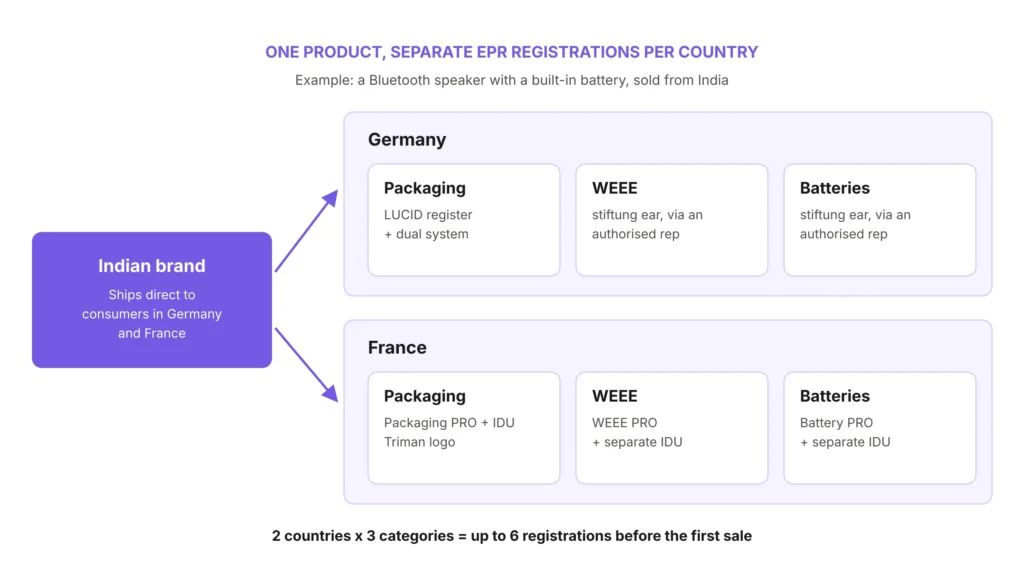
EPR obligations: packaging, WEEE and batteries, in both countries. That’s up to six registrations before the first sale.
| Obligation | Germany | France |
|---|---|---|
| Packaging | LUCID plus a dual system | Packaging PRO and IDU |
| WEEE | stiftung ear, through an authorised representative | WEEE PRO and IDU |
| Batteries | stiftung ear, through an authorised representative | Battery PRO and IDU |
The speaker also needs CE marking under EU product safety laws. If you haven’t covered that yet, read our CE certification guide first. CE marking proves the product is safe to sell. EPR proves you’re paying for its waste. You need both.
What these two examples teach
The product category decides which EPR streams apply. The country decides where you register. Each stream in each country is a separate registration, report and fee. Plan for the full grid before you launch, not after a marketplace blocks your listing.
EPR Compliance for eCommerce Marketplaces
Marketplaces have become the front line of EPR enforcement. In Germany, the Packaging Act makes marketplaces check that sellers are registered in LUCID. In France, producers must share their IDU with the marketplaces that sell their products.
For Indian sellers on Amazon’s European stores, this usually means entering EPR registration numbers in Seller Central for each country and category. Listings without the right number can be suppressed. Our guide to Amazon Global Selling covers the wider setup, and you can compare other channels in our overview of selling on global marketplaces.
Selling through your own website doesn’t get you out of EPR. Marketplaces simply catch missing registrations sooner. On your own store, the risk shows up later, as fines or a sales ban from the national authority.
EPR Registration for Exporters: Step by Step
Here’s a practical sequence that works for most Indian exporters selling to European consumers.
- Map your markets. List every country where you sell to consumers today and every country you plan to launch in the next 12 months.
- Map your categories. For each product, check whether packaging, WEEE, batteries or other streams such as textiles apply.
- Confirm your producer status. Decide, and write into contracts, who is the producer in each country: you, your importer, your distributor or your marketplace fulfilment partner.
- Appoint authorised representatives. Where you sell directly and have no local entity, appoint a representative per country and per stream as the law requires.
- Register and join PROs. Register with each national register and sign up with approved schemes before your first sale.
- Set up data tracking. Record packaging weights by material, and units of electronics and batteries sold, per country. Your reports and fees depend on this data.
- Update labels and listings. Add country-specific marks such as Triman in France, and enter registration numbers on marketplaces.
- Report and pay on time. Diarise each country’s reporting deadlines and renew contracts with representatives and PROs.
Good data is the backbone of steps 6 and 8. If you already weigh and dimension parcels for volumetric weight, extend that habit to record packaging material and weight per SKU.
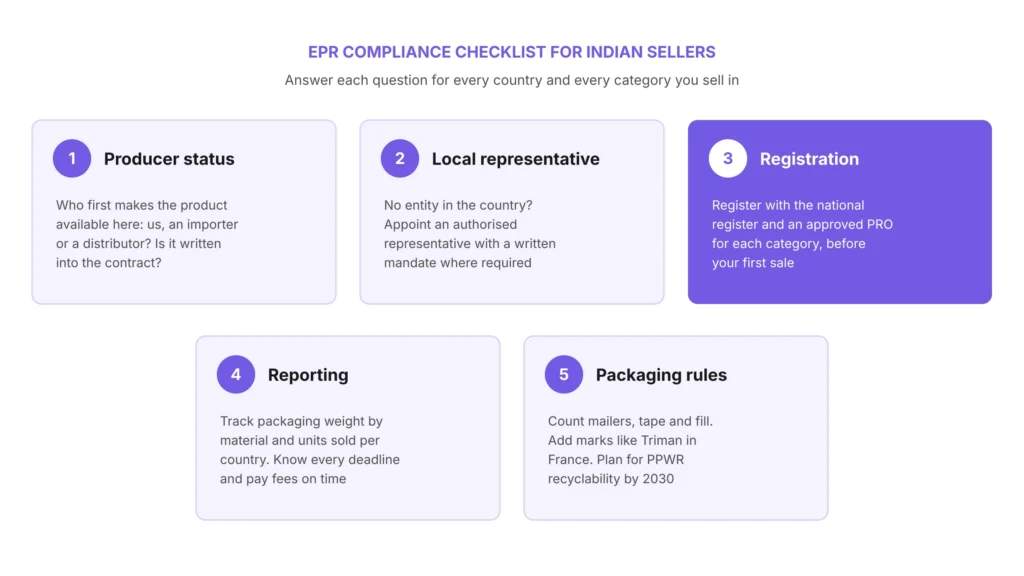
EPR Requirements Checklist: Questions to Ask Before You Ship
Use these questions with your team, your importer or your EPR service provider. If you can’t answer one with confidence, sort it out before you ship.
Producer status
- Who is the producer for each country: us, our importer, our distributor or a fulfilment partner?
- Does our contract with the importer or distributor say who handles EPR?
- Are we the seller of record on any marketplace in this country?
Local representatives
- Do we have a legal entity in this country? If not, do the packaging, WEEE or battery rules require an authorised representative here?
- Has the representative accepted a written mandate, and does it cover every stream we sell under?
Registration
- Which EPR streams apply to each SKU: packaging, WEEE, batteries or others?
- Are we registered with the national register and an approved PRO for each stream, before our first sale?
- Have we entered the correct registration numbers on every marketplace?
Reporting
- Do we know each country’s reporting frequency and deadline?
- Can we pull packaging weight by material, and units of electronics and batteries, by country, from our order data?
- Who files a year-end or completeness declaration, if the country needs one?
Packaging obligations
- Does our shipping packaging, including mailers, tape and fillers, appear in our reports?
- Do we meet country labelling rules, such as Triman in France?
- Is our packaging ready for the PPWR’s recyclability rules due by 2030?
Common EPR Mistakes Indian Sellers Make
Most problems come from a handful of assumptions that sound reasonable but aren’t:
- “We only ship small parcels, so EPR doesn’t apply.” Many countries have no minimum threshold for packaging registration, even if lower fees or simplified reporting apply to small volumes.
- “Our courier or marketplace handles it.” Shipping packaging is still yours unless your contract says otherwise. Some marketplaces offer EPR services in some countries, but you still need to check what they cover.
- “Germany covers the EU.” It doesn’t. Each country is a separate registration.
- “Our Indian EPR certificate is enough.” India’s CPCB registration has no standing in Europe.
- “We’ll register once sales pick up.” Registration usually has to happen before you place products on the market, and registering late can mean paying fees for the periods you missed.
Your packaging choices also affect costs. Lighter packaging made from a single material is often cheaper under fee structures that reward recyclability. Our international shipping packaging tips help you cut weight without risking damage, and our export documents checklist covers the paperwork side of a European launch.
Ship EPR-Ready Orders to Europe With Shiprocket X
Once your registrations are in place, the next challenge is moving orders reliably. Shiprocket X is Shiprocket’s cross-border shipping platform for Indian sellers. It lets you compare international courier options, ship to Europe from one dashboard and track every parcel through to delivery.
A shipping partner doesn’t register you for EPR, but it does shape your compliance data. Recording parcel dimensions and packaging consistently per order makes country-wise packaging reports much easier to build. [[VERIFY: whether Shiprocket X offers country-wise shipment exports or packaging data reports that sellers can use for EPR reporting, and which EU destinations are currently served]] If you’re planning a wider European rollout, our guide on how to export from India to Europe covers market choice and logistics.
Conclusion
EPR requirements look complicated because they’re national, category-based and still changing. The logic is simple, though. Whoever first puts a product and its packaging on a market pays for its end of life. For direct-to-consumer exports, that’s usually you.
Start with the grid: which categories apply to each product, and which countries you sell in. Register each combination, appoint representatives where required, keep clean packaging data, and track the PPWR as its rules roll out. Get that right, and EPR becomes a routine cost of selling in Europe rather than a reason your listings disappear.