

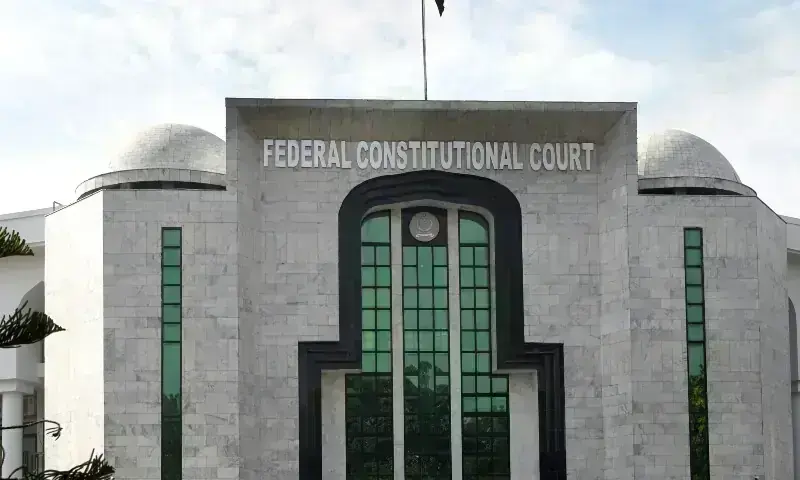
Lawyers and journalists have raised concerns about a recent ruling by the Federal Constitutional Court (FCC), in which it set aside an Islamabad High Court (IHC) judgement in a workplace harassment case filed by a National Bank of Pakistan (NBP) employee in 2012.
Nadia Sarwar, who was employed at NBP since 2008, alleged that the petitioners, Aqeel Abbas and Usman Shahid, had harassed her by misusing their authority.
She alleged that they had forced her to stay in the office after hours and required her to disclose details for applying for medical and other leaves, which would make her “uncomfortable”.
“Besides causing interference in her work and creating the hostile and offensive work environment, the petitioners had also been giving adverse remarks against her performance and also uttered shameful, unethical, scandalous, immoral and un-Islamic words/comments against her,” the FCC verdict noted.
The FCC’s Monday verdict overturned a December 2024 IHC ruling that had set aside the president’s order from 2014 and restored the ombudsman’s 2013 order of the two men’s compulsory retirement.
Authored by Justice Ali Baqar Najafi of the three-member bench, the FCC order reproduced the definition of harassment stated in the Protection against Harassment of Women at the Workplace Act 2010, which lawyers say was amended in 2022.
The 2010 Act describes harassment as “any unwelcome sexual advance, request for sexual favours or other verbal or written communication or physical conduct of a sexual nature or sexually demeaning attitudes, causing interference with work performance or creating an intimidating, hostile or offensive work environment, or the attempt to punish the complainant for refusal to comply to such a request or is made a condition for employment”.
Interpreting that definition, the FCC ruling said that an “act, conduct or attitude has to be sexual in nature, if it is to be covered under the definition of harassment for the purpose” of the 2010 Act.
The FCC order also referred to two rulings issued by the Supreme Court in 2021 and 2025, adding: “With due respect to the view of Supreme Court, we do not agree with this observation well within our powers under Article 189 of the Constitution on the basis of the very definition of sexual harassment under Section 2(h). Any other interpretation would be amounting to reading into the said provision of the Act, 2010.”
‘Sad days as we take steps back’
Lawyer Aaminah Qadir said the FCC verdict went against an SC judgement by a female judge “who actually understands (first-hand) that implications of harassment at work may not always be overtly sexual”.
“Sad days as we take steps back and undermine solid judgements from the SC. Gender gap is sure to widen,” she remarked in a post on X.
Barrister Maleeha Bokhari, in a post on X, said, “With the greatest respect, this judgement is wrong in law and dangerous in effect.”
She argued that in 2022, the Parliament amended section 2(h) of the 2010 Act to include “discrimination on basis of gender, which may or may not be sexual in nature”.
It may be mentioned that the original complaint dates back to 2012, while the 2022 amendments were to be in effect from the date of passage. The president’s order — which set aside the ombudsperson’s decision on the two men’s compulsory retirement — was passed in 2014.
She argued that the FCC judgement contradicted the Constitution’s Articles 14 (dignity of person), 25 (equality before the law) and 34 (ensuring women’s full participation in all spheres of national life).
“As more women enter the workforce and drive Pakistan’s economy, the forms of harassment evolve. Our protections must evolve with them, not shrink,” Bokhari wrote on X.
“Dignity at work is not conditional on the harasser’s intent being sexual.”
Lawyer Reema Omer criticised the reasoning in the verdict and said it “fails victims of harassment”.
She claimed that the order lacked attention paid to “important sections of the law it is supposed to interpret”.
Journalist Benazir Shah contended that the “narrow” interpretation of workplace harassment law would “leave some forms of gender-based harassment outside the law”.
A post by the Women in Law collective said the FCC, in its verdict, had “spent a page defining ‘sexual’” but claimed the ruling lacked assessment based on it in the case at hand.
The collective also criticised the FCC for alleged discrepancies within the verdict.
Advocate Nida Usman, who founded Women in Law, raised concerns about due process and “the cases they have chosen to rely on”.
She noted that the FCC ruling had raised “the evidentiary burden for victims which goes way beyond what the Act requires”.
Elaborating on this, Usman particularly noted the FCC’s observation that to “prove a sexual harassment, a bare minimum requirement is the impartial, credible material, capable of surviving the test of reasonableness and it must be reinforced with convincing/independent evidence”.
She added, “Harassment usually happens without witnesses, although here there were two!”
The advocate also took exception to the FCC’s observation that the 2010 Act “intended to provide smooth working environment for the women by protecting their honour, modesty and respect by virtue of their gender” but did “not provide a special or a preferred treatment so as to undermine the dignity of their counterpart”.
Lawyer Hassan Abdullah Niazi said the FCC judgment “makes Pakistan’s workplace harassment law out of step with international best practices”.
Noting that harassment “operates across a spectrum”, Niazi said the ruling “fixates on one point, leaving countless women without an avenue for redressal”.
FCC’s interpretation
In its ruling, the FCC observed that the meaning of harassment under section 2(h) of the 2010 Act was “only restricted to conduct which is sexual in nature and all other acts of harassment fell beyond such restricted definition of actionable harassment”.
“It can, therefore, be safely said that any misdemeanour, behaviour or conduct unbecoming of an employee at the workplace towards other employee or an employer, or from an employer to an employee… may be generically classified as harassment but is not an actionable act per-se under the Act, 2010 unless such behaviour or conduct is inherently demonstrated or demonstrable of its sexual nature.
“Any grave or devastating conduct or behaviour is not actionable as contemplated in the definition of harassment unless it is sexual in origin,” the FCC stated.
It explained: “The word ‘sex’ an adjective and the word ‘sexual’ is related to the instinct, physiological processes and with physical attraction or intimate physical contact between two individuals.
“A gesture, therefore, made to another person for gaining sexual gratification would fall within the definition of harassment under the Act, 2010 but may have different forms; i.e. verbal, non-verbal or physical but the expression harassment is understood in its ordinary sense explained in the dictionaries.”
In the case, Sarwar had initially filed a complaint with NBP’s president in September 2012, then approached its divisional head, and filed another complaint to the bank president.
Receiving no relief, she finally filed a complaint before the federal ombudsman under the 2010 Act. The complaint was allowed and the petitioners were awarded the major penalty of compulsory retirement under Section 4(4)(ii)(b) of the Act.
The petitioners then filed representations before the president on Feb 14, 2014. The representations were allowed to the extent of setting aside the compulsory retirement order. However, the bank was directed to award censure under Section 4(4)(i)(a) of the Act.
When Sarwar challenged the order before the IHC, the president’s order was set aside and the ombudsperson’s order was restored in toto.
In Monday’s ruling, setting aside the IHC ruling, the FCC said “an act, conduct or attitude has to be sexual in nature” to constitute actionable harassment under the Act and that the ombudsperson had no jurisdiction to inquire into disciplinary proceedings beyond this scope.
