

A buyer in Dubai orders your Bluetooth speaker, and another in Toronto wants a smartwatch with a spare charging case. The products are ready and the invoices are made. Then the courier asks a question you didn’t expect: what’s the battery’s watt-hour rating, and is it installed or packed separately?
That question is at the heart of the international shipping requirements for electronics. Phones, earbuds, power banks, trackers and smart devices nearly all run on lithium batteries, and aviation rules class lithium batteries as dangerous goods. Get the battery details wrong and a parcel can be refused at pickup, held at the hub or sent back from the airport.
This guide is for Indian sellers who want to export electronics from India without those surprises. It explains the three battery configurations, the specifications carriers ask for, packaging and labelling, paperwork, and a pre-booking checklist to run through with your shipping provider.
Most electronics aren’t risky because of the circuit board. The risk comes from the battery. A damaged or short-circuited lithium cell can overheat and catch fire, and a fire in an aircraft hold is very hard to put out.
That’s why the UN, the International Civil Aviation Organization (ICAO) and IATA all classify lithium batteries as Class 9 dangerous goods. Airlines and express couriers follow the IATA Dangerous Goods Regulations, which are based on the ICAO Technical Instructions. In India, the Directorate General of Civil Aviation (DGCA) oversees how dangerous goods move by air.
Because nearly all cross-border ecommerce parcels fly, these air rules decide what you can send. They sit alongside the usual export steps, such as your IEC, HS code and courier shipping bill, and alongside the general list of prohibited items for international shipping.
Electronics that usually need a battery check include:
- smartphones, tablets and laptops;
- earbuds, headphones and Bluetooth speakers;
- smartwatches and fitness bands;
- power banks and spare batteries;
- cameras, drones and GPS trackers;
- toys, grooming devices and anything else with a rechargeable cell.
Standalone, Packed With or Contained In: The Three Battery Configurations
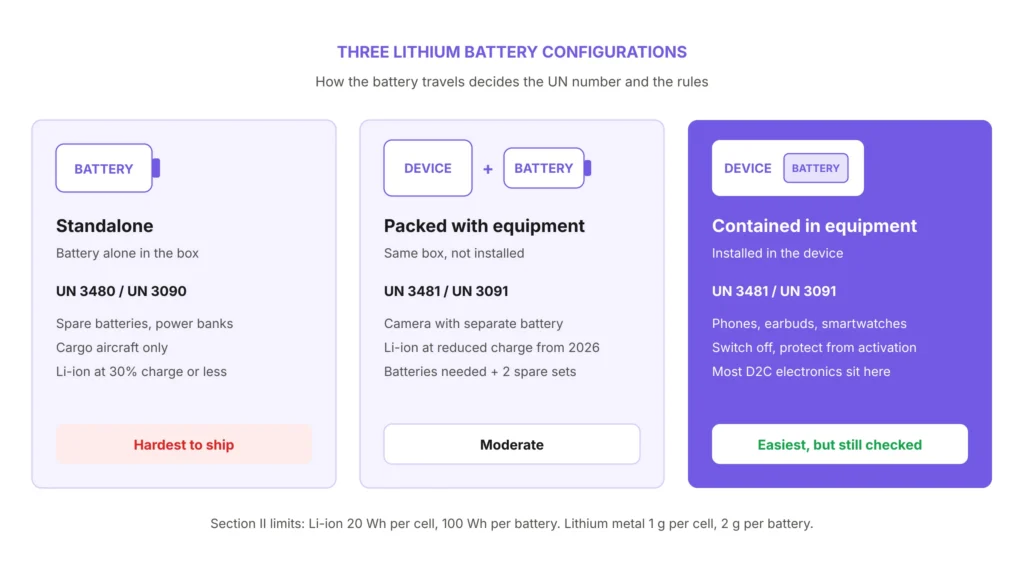
Air rules sort every lithium battery shipment by how the battery travels. This one detail changes the UN number, the packing instruction and whether a courier will take the parcel at all.
Standalone Batteries
These are batteries shipped on their own, with no device in the box. Spare phone batteries, replacement laptop batteries and power banks fall here. Lithium-ion batteries in this group are UN 3480, and lithium metal batteries are UN 3090.
This is the most restricted group. Standalone lithium-ion and lithium metal batteries are forbidden on passenger aircraft and can only fly on cargo aircraft. Lithium-ion batteries shipped this way must also be at a state of charge of no more than 30% of their rated capacity.
Batteries Packed With Equipment
Here the battery and the device share a box, but the battery isn’t installed. A camera sold with a separate battery in the same carton is a typical example. Lithium-ion batteries packed this way are UN 3481, and lithium metal batteries are UN 3091.
From 1 January 2026, lithium-ion batteries packed with equipment must also be shipped at a reduced state of charge, generally no more than 30%. You can usually include only as many batteries as the device needs to run, plus two spare sets.
Batteries Contained in Equipment
The battery is installed in the device, as in a phone, smartwatch or Bluetooth speaker. These also use UN 3481 for lithium-ion and UN 3091 for lithium metal, under separate packing instructions.
This is the easiest configuration to ship, and it’s where most D2C electronics sit. Even so, it isn’t automatically accepted everywhere. The device still has to meet the battery size limits, be protected from switching on, and travel in strong packaging.
| Configuration | Lithium-ion | Lithium metal | IATA packing instruction | How hard to ship |
|---|---|---|---|---|
| Standalone, including power banks | UN 3480 | UN 3090 | PI 965 / PI 968 | Hardest: cargo aircraft only |
| Packed with equipment | UN 3481 | UN 3091 | PI 966 / PI 969 | Moderate |
| Contained in equipment | UN 3481 | UN 3091 | PI 967 / PI 970 | Easiest, but still checked |
Where Power Banks Fit
A power bank is treated as a battery, not as a device, because its only job is to store and supply power. So it ships as a standalone battery under UN 3480. This catches out many sellers who list power banks as “accessories”. If you sell them, ask your shipping provider whether any of its international services accept UN 3480 before you take overseas orders.
Battery Specifications Carriers Will Ask For
Carriers can’t judge a battery by its looks. Before they accept a shipment, they need numbers from the manufacturer’s datasheet or label.
- Chemistry: lithium-ion (rechargeable) or lithium metal (usually non-rechargeable, such as coin cells).
- Watt-hour rating (Wh) for lithium-ion: the Section II limits are 20 Wh per cell and 100 Wh per battery.
- Lithium content for lithium metal: the limits are 1 g per cell and 2 g per battery.
- Number of cells or batteries per device and per package.
- Net weight of the batteries in each package.
- UN 38.3 test summary: proof that the battery design has passed the UN transport tests.
If the label shows only voltage and milliamp-hours, you can work out the rating: Wh = V x Ah. A 3.7 V, 5,000 mAh battery works out at 3.7 x 5 = 18.5 Wh, which is under the 100 Wh battery limit.
Batteries within these limits can usually go under the lighter “Section II” rules. Larger batteries are fully regulated. They need a trained shipper, UN-specification packaging, a Shipper’s Declaration for Dangerous Goods and a carrier with a dangerous-goods service.
The UN 38.3 summary matters more than many sellers think. Manufacturers and distributors must make it available, so ask your supplier for it when you buy stock. No summary often means no booking.
Never ship batteries that are damaged, swollen, defective or under a safety recall. Air rules forbid them outright, whatever the packaging.
Packaging and Labelling Requirements
Good packaging for electronics has two jobs: stop the battery from short-circuiting, and stop the device from switching on in transit.
- Protect terminals with caps, tape or individual bags so they can’t touch metal or each other.
- Switch devices off and disable wake features or alarms where you can.
- Use a strong, rigid outer box, and cushion the device so it can’t move. For tips on box choice and void fill, read our guide to international shipping packaging tips.
- Keep the original retail packaging inside the outer carton where possible. It’s designed to protect the product.
- Pack each battery in its own inner packaging if it isn’t installed.
On the outside of the box, the label you need depends on the battery and configuration:
- Lithium battery mark: the red-hatched mark with the UN number and a phone number. It’s needed on most Section II packages. Very small consignments of devices with batteries installed can be exempt, so ask your carrier.
- Class 9 lithium battery hazard label: for fully regulated shipments.
- Cargo Aircraft Only label: for standalone batteries and other shipments that can’t fly on passenger planes.
Don’t add labels you don’t need. A lithium mark on a box that doesn’t contain batteries, or an old label left on a reused carton, can get a parcel stopped. Use a fresh box for every battery shipment.
Documents for Shipping Electronic Products Overseas
International electronics shipping needs the usual export documents plus some battery paperwork.
- Commercial invoice: a precise description, such as “Bluetooth speaker with lithium-ion battery installed, 18.5 Wh”, not just “electronics”. Read more on what goes into a commercial invoice.
- HS code: most electronics fall under Chapter 85 of the tariff, and storage batteries sit under heading 8507. Confirm the full code for each product with our guide to HS codes in international shipping.
- IEC and courier shipping bill: you need an Import Export Code, and the courier files a CSB-IV or CSB-V for you. Our CSB-IV vs CSB-V guide explains which applies.
- UN 38.3 test summary and, often, the battery’s Safety Data Sheet.
- Shipper’s Declaration for Dangerous Goods: for fully regulated shipments only.
Some advanced electronics, such as encryption devices, drones or certain sensors, can also fall under export controls. Check whether your product needs a SCOMET declaration for exports before you ship.
Destination Rules Still Apply
Meeting air transport rules gets your parcel on the plane. It doesn’t guarantee the product can be sold in the destination country. Many markets have their own rules for radio, wireless and battery-powered goods, such as radio equipment approvals, product safety marks and battery labelling.
Some countries also limit lithium batteries in postal or courier imports. Check the rules for your destination before you list a product there.
Why Carrier Acceptance Varies
Air rules set the minimum. Every carrier then decides what it will actually carry, and many go further than the rules require. That’s why one courier may take a smartwatch to the UK and refuse the same watch to another country.
Acceptance usually depends on four things:
- Battery type: lithium-ion and lithium metal have different rules, and some carriers won’t take standalone lithium metal batteries at all.
- Configuration: devices with batteries installed are widely accepted, packed-with is more limited, and standalone batteries and power banks are often refused.
- Destination and route: some countries and routes restrict lithium battery shipments, and some only accept them on certain services.
- Service: economy and postal-style services often exclude batteries that a premium express service accepts, and fully regulated shipments need a dangerous-goods account.
Major express carriers like DHL Express require shippers to be approved before they send shipments needing lithium battery marks or labels. So don’t assume every courier accepts every battery-powered product. Comparing international shipping carriers on their battery policy is as important as comparing rates.
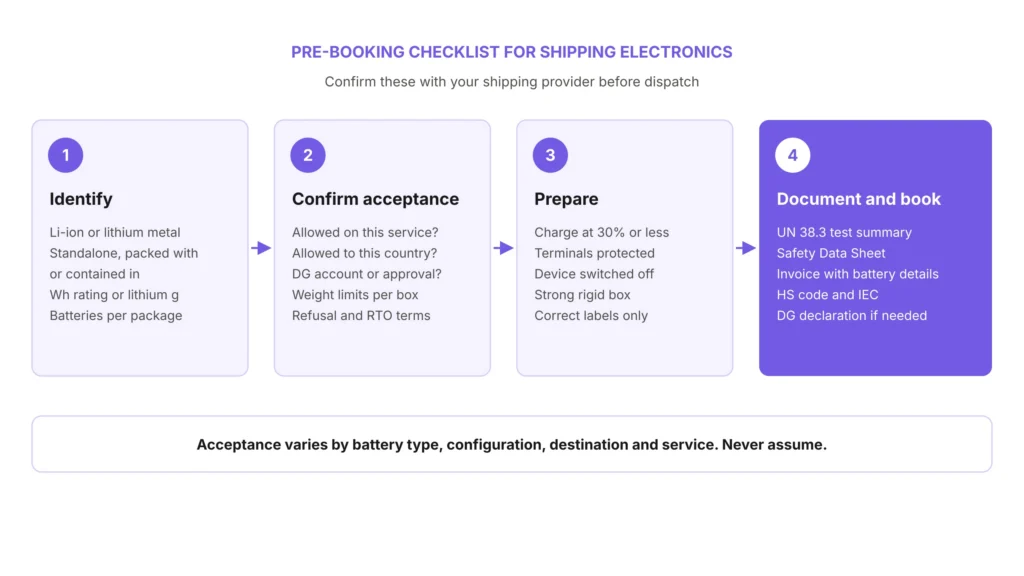
Pre-Booking Checklist: What to Confirm With Your Shipping Provider
Run through these questions before you book, ideally before you even list a product for overseas buyers.
- Is my product allowed on this service? Share the product type and battery configuration: standalone, packed with or contained in.
- Is it allowed to this destination? Ask about country-specific limits and remote areas.
- Is the battery within limits? Share the Wh rating or lithium content and the number of batteries per package.
- What state of charge is needed? Confirm whether batteries must be at 30% or less.
- Which labels go on the box, and does the carrier supply them?
- What documents do you need? Usually the UN 38.3 summary, the Safety Data Sheet and a detailed invoice.
- Do I need a dangerous-goods account or written approval for this shipment?
- What happens if the parcel is refused? Ask about return-to-origin charges and timelines.
- Is there a weight limit per box or per shipment for battery goods?
Save the answers for each product and destination. Next time, you can book in minutes instead of starting from scratch.
Ship Electronics Abroad With Shiprocket X
Shiprocket X is Shiprocket’s cross-border shipping platform for Indian sellers. It lets you ship to 220+ countries and territories from one dashboard, compare international courier options and upload orders under CSB-IV and CSB-V.
For battery-powered products, share the battery type, configuration and Wh rating when you contact the team, so they can tell you which services accept the shipment. [[VERIFY: which battery configurations (contained in, packed with, standalone/power banks) and destinations Shiprocket X courier partners currently accept]] For more help with destinations and paperwork, read our guide to shipping internationally from India by courier.
Conclusion
The international shipping requirements for electronics look complicated, but they mostly come down to the battery. Work out whether it’s standalone, packed with or contained in the device. Know its Wh rating or lithium content, keep the UN 38.3 summary to hand, and pack and label the box for that configuration.
Then confirm acceptance with your shipping provider for each product, service and destination before you dispatch. A five-minute check up front costs far less than a refused parcel or a shipment stuck at the airport.